
Last updated: July 2026
Every Seoul guidebook sends you to “a traditional market” as if there were only one. There are hundreds — and they’re wildly different. One is a midnight wholesale machine, one trades ginseng and medicinal herbs next to a Starbucks built inside a 1960s cinema, one only exists every fifth day. Pick the wrong one for what you want and you’ll wonder what the fuss was about. Pick the right one and it’s the best afternoon of your trip.
This guide covers ten markets — seven in Seoul, three a short train ride away — with what each is actually for, how to get there, and what to eat when you arrive.
TL;DR
- First market ever? Go to Gwangjang (food theater) or Tongin (build-your-own lunchbox with brass coins).
- Buying things, not photos? Namdaemun for kitchenware, glasses and kids’ clothes; Dongdaemun’s retail malls for fashion.
- Local life, no tour buses: Mangwon in Seoul, Sinpo in Incheon, Suwon’s Paldalmun cluster with its fried-chicken alley.
- The spectacle: Moran Five-Day Market — Korea’s biggest folk market, but only on dates ending in 4 or 9.
- Most stalls take cards, but carry some cash; markets keep loose hours and per-stall days off, so treat times as approximate.
- Getting around is a T-money tap away — set up with our T-money guide and transit passes guide.
How to “Do” a Korean Market
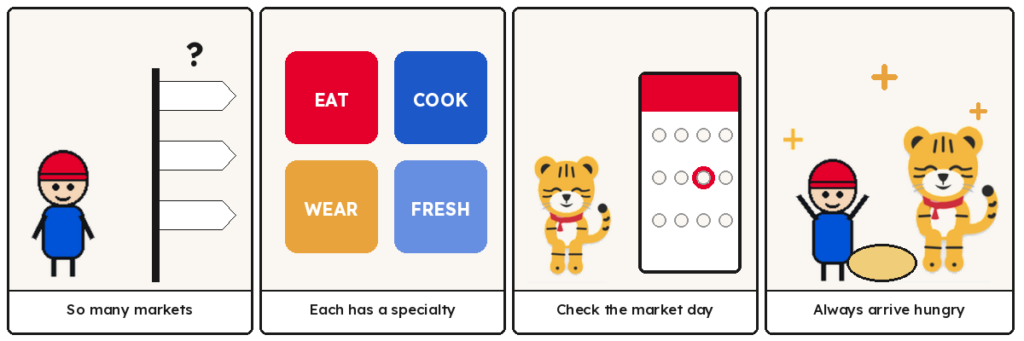
Three habits make any market day better. Go hungry — the food alleys are the point, and grazing beats one big meal. Carry a little cash — most stalls take cards these days, but the oldest vendors and the ₩1,000 snacks move faster with bills, and an eco-bag saves you buying one. Check the day — traditional markets run roughly morning to early evening, each stall sets its own day off, and a few (noted below) have fixed closing days. If a market is the whole reason for your trip, confirm before you ride out.
One more mindset shift: a Korean market is not a souvenir bazaar with one of everything. Each has a specialty — that’s the whole game. Here they are, matched to yours.
Seoul’s Big Seven
Gwangjang Market — the food theater
Korea’s most famous market meal, in a market that’s been trading since 1905. The covered central cross of alleys is wall-to-wall food stalls: bindaetteok (mung-bean pancakes fried in front of you), the little “mayak” gimbap, yukhoe (beef tartare) alley, knife-cut noodles. Upstairs and around the edges live the older trades — hanbok, silk, bedding — plus the famous vintage clothing arcade, best visited in the daytime since hours up there vary by shop. It’s packed, loud, touristy and still genuinely great. One street-smart tip: after past overcharging controversies, many stalls now display set prices — order from a posted menu, and confirm the price first when there isn’t one.
- Location: Jongno 5-ga, central Seoul · Getting there: Jongno 5-ga Station (Line 1) exits 7–8, right into the market; Euljiro 4-ga (Lines 2·5) also works
- Scale: a sprawling city block of stalls and upstairs arcades
- Best for: street-food grazing, vintage hunting, people-watching
- (Eating solo here is easy — stall counters are made for it. See our eating alone guide.)
Namdaemun Market — the everything market
Korea’s largest traditional market — roughly 10,000 shops and, by Seoul’s own count, around half a million visitors a day. This is where you buy things: kitchenware and tableware arcades, dried seafood and gim, camera and glasses shops (a famous bargain — see our budget shopping guide), and a children’s-wear cluster that dominates the national kids’ clothing trade. Feed yourself in the kalguksu alley (noodles with free extras) or the galchi-jorim alley (braised cutlassfish). Wholesale and retail share the lanes, so mornings hum with shop owners restocking.
- Location: next to Sungnyemun Gate (Namdaemun), City Hall area · Getting there: Hoehyeon Station (Line 4) exit 5, you’re in it
- Scale: around 10,000 shops — Korea’s biggest
- Best for: kitchenware, glasses, kids’ clothes, practical souvenirs
- Note: many shops rest Sundays; the food alleys largely keep going.
Dongdaemun Market — fashion, two speeds
One name, two markets. The retail side — mall towers like Doota and Migliore plus the surrounding shopping streets — runs late morning to late night, fixed-price and card-friendly: that’s the one for visitors, with the futuristic DDP building next door for a photo stop. The wholesale night market (roughly 8 p.m. to dawn, bundles, cash, brisk) exists for shop owners, not browsers — fun to glimpse, frustrating to shop.
- Location: Dongdaemun, east downtown · Getting there: Dongdaemun History & Culture Park Station (Lines 2·4·5)
- Scale: multiple mall towers plus street blocks of stalls
- Best for: fashion, fabrics (the arcade’s fabric floors are legendary), late-night shopping
Tongin Market — the brass-coin lunchbox
A small neighborhood arcade near Gyeongbokgung with one beloved gimmick: the Dosirak Café. Buy a strip of old-style brass coins (₩500 each), take an empty lunch tray, and fill it dish by dish from participating stalls — the classic pick is gireum-tteokbokki, the chewy pan-fried “oil tteokbokki” this market is known for. It’s cheap, interactive and perfect between palace visits. The lunchbox café runs lunch hours only (roughly 11:00–16:00 weekdays, to 17:00 weekends) and rests Tuesdays and the third Sunday — check before making a special trip.
- Location: Seochon, west of Gyeongbokgung Palace · Getting there: Gyeongbokgung Station (Line 3) exit 2, ~5-minute walk
- Scale: one compact covered lane, food-heavy
- Best for: the coin-lunchbox experience, a light lunch near the palaces
Mangwon Market — where locals actually shop
The un-touristy counterweight: a single covered lane of about 90 shops in Mangwon-dong, where the clientele is neighborhood grandmothers and Hongdae twenty-somethings, not tour groups. Produce and side dishes up front, and a quietly excellent snack scene — croquettes, kalguksu, cup snacks, market chicken — at student prices. Pair it with a walk to the Han River park nearby.
- Location: Mangwon-dong, Mapo (west Seoul) · Getting there: Mangwon Station (Line 6) exit 2, ~5-minute walk
- Scale: about 90 shops in one lane
- Best for: everyday market life, cheap eats, zero tourist markup
Gyeongdong Market — herbs, ginseng and a cinema Starbucks
Seoul’s great traditional-medicine market: the adjoining Yangnyeongsi herbal district counts roughly 800 shops trading ginseng, roots, bark and dried everything — the smell alone is worth the trip. Then the plot twist: inside the market sits Starbucks Gyeongdong 1960, built into a shuttered 1960s cinema with the tiered seating intact, plus a youth mall and a weekend night market (Fri–Sun). Old Korea and new Korea, one roof apart.
- Location: Jegi-dong, northeast Seoul · Getting there: Jegi-dong Station (Line 1) exit 2
- Scale: a full district — produce halls plus ~800 herbal-medicine shops
- Best for: ginseng and herbal souvenirs, atmosphere, that Starbucks photo
Noryangjin Fisheries Wholesale Market — pick it, then eat it upstairs
One of Korea’s largest fish markets, running on a simple loop: browse the tanks on the ground floor, buy your fish or crab, then carry it to an upstairs restaurant that cooks it for a per-person service and prep fee — sashimi first, spicy stew after. Pre-dawn auctions feed the floor; visitors mostly come for lunch and dinner. Agree on both the fish price and the cooking fee before you commit, and you’ll have one of Seoul’s best seafood meals.
- Location: Noryangjin, south bank of the Han · Getting there: Noryangjin Station (Lines 1·9), footbridge to the market
- Scale: a vast modern hall of hundreds of vendors
- Best for: ultra-fresh seafood, the buy-downstairs-eat-upstairs ritual
Worth the Train: Gyeonggi & Incheon
Suwon Paldalmun (Nammun) Markets — nine markets, one fortress
By the south gate of UNESCO-listed Hwaseong Fortress sits Gyeonggi-do’s biggest market zone: nine adjoining markets trading as one. Highlights: Jidong Market’s sundae town (~40 blood-sausage soup houses in a row), Motgol Market for fresh food, fabric-and-hanbok lanes in Yeongdong Market — and the star, the fried-chicken alley: a ~400-meter run of old-school chicken houses behind Paldalmun where whole birds come out of cauldron oil, made nationally famous by TV. Come hungry, stay for the fortress walls at sunset.
- Location: around Paldalmun Gate, central Suwon · Getting there: Suwon Station (Line 1) then a short bus or taxi ride; or roughly a 15-minute walk from Maegyo Station (Suin-Bundang Line)
- Scale: nine markets — Gyeonggi’s largest cluster (Paldalmun Market alone counts ~215 shops)
- Best for: chicken alley, sundae-gukbap, a market day wrapped in a fortress
Moran Folk Five-Day Market (Seongnam) — the calendar market
Korea’s largest five-day folk market, and it only exists on dates ending in 4 or 9 (the 4th, 9th, 14th, 19th, 24th, 29th). On market day about 554 registered stalls blanket a riverside lot with parasols: grains and roots, live plants and flowers, puppies, hand-pulled kalguksu, cauldron-fried chicken, and rural-Korea energy you won’t find inside Seoul. Hours run roughly 9 a.m. to 7 p.m.; on any other date there’s simply nothing there — check the calendar twice.
- Location: Seongnam, just southeast of Seoul · Getting there: Moran Station (Line 8 / Suin-Bundang) exit 5, it starts at the exit
- Scale: ~554 stalls on market day — Korea’s biggest five-day market
- Best for: the old-school jangnal (market day) spectacle
Sinpo International Market (Incheon) — the original dakgangjeong
Born in Incheon’s 1880s port-opening era as a trading ground for foreign goods, Sinpo is now a compact food market with an outsized claim to fame: it’s the birthplace of dakgangjeong — sweet-spicy glazed fried chicken — and the lines at the original stalls have been a fixture since the 1970s. It also claims the invention of jjolmyeon (chewy spicy noodles) and hometown status for a famous dumpling chain, plus gonggalppang (hollow crisp bread) from charcoal ovens. Fold it into a day with Incheon’s Chinatown and Fairy-Tale Village, all walkable.
- Location: Sinpo-dong, old-town Incheon · Getting there: Sinpo Station (Suin-Bundang Line), right by the market; ~10-minute walk from Dongincheon Station (Line 1)
- Scale: a compact grid of food-first lanes with a youth mall and a lighthouse photo park
- Best for: dakgangjeong pilgrimage, port-town history, a Chinatown combo day
Common Problems
“I went and half the shops were shut.” Markets keep loose, per-stall schedules — and a few have hard closing days (Tongin’s lunchbox café: Tuesdays and the third Sunday; many Namdaemun shops: Sundays; Moran: only on 4/9 dates). Late morning to mid-afternoon is the safe window almost everywhere.
“The stall had no prices.” Common at food stalls. Do what locals do: order from stalls with posted prices, or ask the price before you sit. This one habit removes nearly all overcharging risk.
“Dongdaemun at 11 p.m. was cash-only chaos.” You wandered into the wholesale side. Head back to the mall towers and shopping streets — fixed prices, cards welcome.
“Can I pay with my foreign card?” Usually yes at established shops, less reliably at tiny stalls — carry some cash. A WOWPASS works like a local card and doubles as T-money; details in our budget shopping guide.
FAQ
Which single market should a first-timer pick? For food and spectacle, Gwangjang. For actual shopping, Namdaemun. If you’re palace-hopping anyway, Tongin slots in perfectly.
Are markets open on Sundays? Mostly yes for food areas, but it’s the most common rest day for goods shops — Namdaemun especially thins out. Moran only runs on 4/9 dates regardless of weekday.
Do vendors speak English? At tourist-heavy markets (Gwangjang, Namdaemun), enough to transact; elsewhere, pointing plus a translation app does fine — our essential apps guide covers the setup.
Can I haggle? Gently, at goods stalls when buying several items — never at food stalls or fixed-price shops. A smile beats a hard bargain every time.
Is market food safe to eat? As safe as street food gets — high turnover means fresh oil and fast-moving stock. Standard travel rules apply: busy stalls, cooked-hot food, bottled water if you’re cautious.
Official Resources
- Visit Seoul (english.visitseoul.net) — official pages for Gwangjang, Namdaemun, Tongin and more.
- Korea Tourism Organization (english.visitkorea.or.kr) — market listings nationwide, including Moran’s schedule.
- Incheon Tourism (itour.incheon.go.kr) — Sinpo International Market and the old-town walking area.
- Suwon Cultural Tourism (visitsuwon.or.kr) — the Paldalmun market cluster and Hwaseong Fortress.
- New here? Get moving first with our T-money card guide, or browse all guides.