
Last updated: July 2026
Every summer, Korea runs on cold noodles. Queues form outside noodle houses before they open, offices empty at noon, and somebody will absolutely tell you that the place they go to is the only real one.
Then you sit down, and the menu says 물냉면 and 비빔냉면, and you pick one at random.
Here's the thing that guide after guide gets wrong: that isn't the distinction that matters. And there's a second thing almost nobody mentions in English, which genuinely matters if you have a food allergy.
TL;DR
- The real split is the noodle, not the broth. Pyeongyang-style noodles are mostly buckwheat; Hamheung-style are mostly starch (sweet potato or potato). Chewiness, colour, and taste all follow from that.
- If you have a buckwheat allergy, ask before you order. Buckwheat is a recognised allergen in Korea, but ordinary restaurants are not required to label it. The dish is built on it.
- Budget about ₩12,000–14,000 for a bowl in Seoul. It's no longer a cheap meal.
- It was originally a winter food. The summer association is modern — refrigeration changed the habit, not the recipe.
The distinction that actually matters
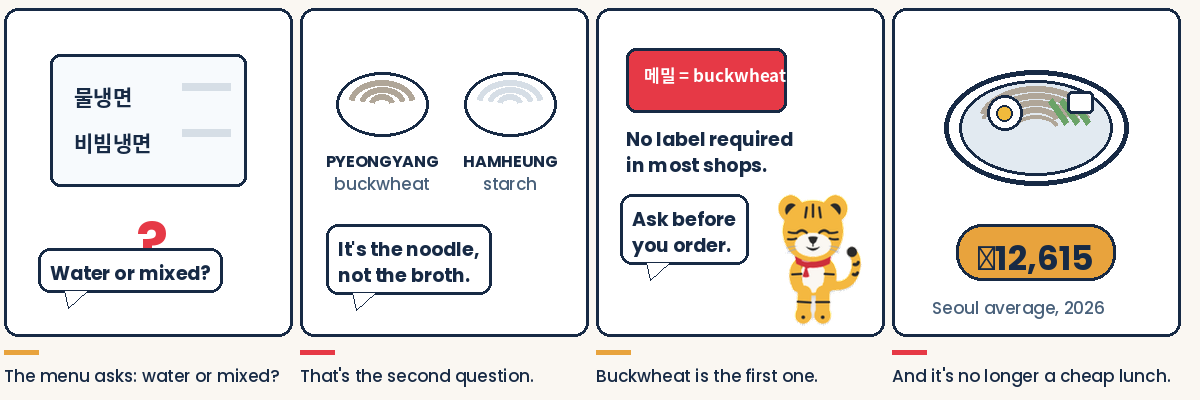
Ask for naengmyeon in Korea and you'll usually be asked back: mul (물, water) or bibim (비빔, mixed)? That's broth versus sauce, and it's a real choice — but it's the second question, not the first.
The first question is what the noodle is made of, and that traces back to two regional traditions, both from what is now North Korea.
Pyeongyang-style (평양냉면) uses noodles made largely from buckwheat. They're greyish-brown, soft enough to bite through cleanly, and they arrive in a cold, pale broth that first-timers almost universally describe as bland. It isn't bland — it's restrained. The flavour is in the broth's depth rather than in salt, sugar, or heat. Plenty of Koreans didn't like it on their first try either, and then found themselves craving it two summers later.
Hamheung-style (함흥냉면) uses noodles made largely from starch — sweet potato or potato. They're translucent, springy, and noticeably harder to chew through. This style is usually served bibim: no broth, a glossy red chilli sauce, and often a topping of seasoned raw skate or other fish (회냉면, hoe-naengmyeon).
So the pairing you'll meet most often is Pyeongyang-with-broth and Hamheung-with-sauce — but plenty of restaurants serve both formats, which is exactly why the menu alone won't tell you what you're getting.
If your first bowl disappointed you, there's a fair chance you had the style you'd have disliked in any language. Try the other one before you write off the whole category.
The part with actual safety stakes: buckwheat
This is the section this guide exists for.
Buckwheat is one of Korea's officially recognised allergens — it sits on the food labelling list alongside eggs, milk, peanuts, and shellfish. In parts of East Asia buckwheat allergy is a well-documented cause of severe reactions, and Pyeongyang-style naengmyeon is built almost entirely on it.
Now the part that catches people out: that labelling requirement applies to packaged food, not to your average restaurant. In Korea, allergen labelling on prepared dishes is required only for a narrow category of businesses — broadly, larger franchise operations serving food to children. An independent noodle house, which is exactly where you'd want to eat naengmyeon, has no obligation to tell you what's in the noodle.
There's a further trap. Buckwheat isn't confined to the obvious dish. It turns up in makguksu (막국수), in some soba-style noodles, in certain pancakes and dumpling wrappers, and in the complimentary buckwheat tea (메밀차, memil-cha) that some restaurants pour by default. "I'll order something else" is not a reliable strategy inside a naengmyeon restaurant.
If buckwheat is a problem for you, learn these two lines and use them before ordering, not after:
저는 메밀 알레르기가 있어요. Jeo-neun me-mil al-le-reu-gi-ga i-sseo-yo. I have a buckwheat allergy.
이 음식에 메밀이 들어가나요? I eum-sik-e me-mil-i deu-reo-ga-na-yo? Does this dish contain buckwheat?
Have them ready as text on your phone — noodle houses at lunchtime are loud and fast. If you carry an epinephrine auto-injector, carry it. And know that Korea's emergency number is 119, which we cover in our guide to emergency numbers in Korea.
None of this is a reason to avoid naengmyeon. It's a reason to ask one question first.
How to order without stalling the queue
Naengmyeon restaurants at lunch move quickly. Knowing four words is enough.
- 물냉면 (mul-naengmyeon) — cold broth
- 비빔냉면 (bibim-naengmyeon) — chilli sauce, no broth
- 곱빼기 (gop-ppae-gi) — a large portion, usually a small surcharge
- 사리 추가 (sa-ri chu-ga) — an extra portion of noodles added to your bowl
Hold up one finger and say "물냉면 하나요" and you're done.
Two things may land on your table before the food, and both confuse newcomers. One is a small cup of hot broth — this is normal, it's meant to be sipped while you wait, and yes, it's warm on purpose. The other, in some places, is that buckwheat tea mentioned above.
Vinegar, mustard, and the scissors
Every table has a vinegar bottle and a tube of hot mustard (연겨자, yeon-gyeoja). What you do with them is where Koreans stop agreeing with each other.
The purist position, associated with Pyeongyang-style: taste the broth first, add nothing, and let it be what it is. The pragmatic position: a splash of vinegar and a squeeze of mustard sharpen a broth that can otherwise read as flat. Both camps are large and neither is wrong.
The reasonable move for a newcomer is to drink a spoonful of broth plain, then decide. If you add, add a little — the broth is not designed to absorb much.
Then there's the scissors. Staff will often offer to cut your noodles, because a full portion is long and awkward to eat. In Hamheung-style bowls, where the noodles are genuinely tough, most people accept. Among Pyeongyang-style devotees, cutting is close to sacrilege — the noodle's softness is the point, and it's meant to break under your teeth.
You can decline with 안 잘라 주세요 (an jal-la ju-se-yo) — please don't cut it. Nobody will mind either way.
What it costs, and why that surprises people
Naengmyeon used to be a cheap lunch. It isn't any more.
The Korea Consumer Agency tracks the price of everyday dishes, and as of April 2026 a single portion in Seoul averaged ₩12,615 — up 4.13% on the same month a year earlier. Seoul is the most expensive place in the country for it; several provinces sit around ₩10,000–11,000, and the cheapest region is under ₩10,000. Well-known specialist restaurants in Seoul sit well above the average, with ₩15,000–18,000 now common at the top end.
The price has become a minor national talking point precisely because it used to be a working lunch and now isn't. If you're eating out often, our guide to eating alone in Korea covers cheaper everyday options, and Seoul's traditional markets will feed you well for a fraction of it.
Where naengmyeon actually shows up in Korean life
After grilled meat. Order naengmyeon at a Korean barbecue restaurant and it arrives at the end, after the pork or beef — a cold, sharp counterweight to an hour of grilled fat. Many people's favourite bowl is this one, and it's usually cheaper than at a specialist restaurant. (We'll cover barbecue restaurant etiquette properly in a future guide.)
In Busan, it's a different noodle entirely. Ask for cold noodles in Busan and you'll likely be pointed at 밀면 (milmyeon) — wheat noodles rather than buckwheat. It has a specific origin: during the Korean War, refugees from the north who couldn't get buckwheat or potato starch in Busan rebuilt the dish using the wheat flour arriving as aid. It's sweeter, tangier, more assertively seasoned, and generally cheaper. It is not a lesser naengmyeon; it's its own thing, and Busan will tell you so.
In summer — but that's the modern habit. Historically this was a winter dish. Buckwheat noodles fall apart in hot broth, so they were always eaten cold; and the classic broth drew on dongchimi, the radish water kimchi that came into its own in winter. Eating icy noodles in a heated room in January was the original luxury — UNESCO's own record of the tradition describes families gathering for a bowl the day before Jeongwol Daeboreum, the first full moon of the lunar year, hoping their lives will run as long as the noodles. Year-round refrigeration flipped the season, not the recipe. If you're bracing for your first Korean summer, our summer survival guide covers the rest of it.
One piece of context worth having
In 2022, the "Pyongyang Raengmyon custom" was inscribed on UNESCO's Representative List of the Intangible Cultural Heritage of Humanity.
The detail that gets flattened in English coverage: the inscription was submitted by North Korea, not South Korea. It's a genuine listing, and it says something about how seriously this dish is taken on both sides of the border — but if you repeat it at a table in Seoul, get that part right.
FAQ
Is naengmyeon vegetarian? Usually not. The broth is typically built on beef, and bowls are commonly topped with sliced brisket and egg. Some restaurants use a dongchimi-forward broth, but you should assume meat unless told otherwise. Ask: 고기 육수인가요? (Go-gi yuk-su-in-ga-yo?) — is it a meat broth?
Is it gluten-free? No, and don't assume. Pure buckwheat noodles are rare — most commercial noodles blend in wheat flour for structure, and milmyeon is wheat by definition. If you have coeliac disease, this dish is not a safe default.
Why does the broth taste of almost nothing? If it's Pyeongyang-style, that's the intended flavour. Give it three or four spoonfuls before judging. If it still doesn't land, order Hamheung-style next time — the sauce version is much more immediately legible to a new palate.
Why is my bowl slushy? Some restaurants serve the broth as salt-eoreum (살얼음) — chilled to a thin slush just above freezing. It's deliberate and it's a good sign.
Can I get it in winter? Yes. Specialist restaurants serve it year-round, and eating it in winter is the historically authentic move.
What's the difference between naengmyeon and makguksu? Makguksu (막국수) is a buckwheat noodle dish from Gangwon Province — coarser, often served with a sauce and vegetables. Same core ingredient, different tradition. The buckwheat allergy warning above applies to it equally.
Official Resources
- Korea Food & Drug Administration (MFDS) — food allergen labelling rules and consumer information: https://www.mfds.go.kr
- Korea Consumer Agency, Chamgagyeok — official tracking of everyday dining prices, including naengmyeon: https://www.price.go.kr
- UNESCO Intangible Cultural Heritage — the Pyeongyang cold noodle inscription record: https://ich.unesco.org
- Emergency medical assistance in Korea — 119 (fire/ambulance), English support available
This guide is general information, not medical advice. If you have a diagnosed food allergy, follow your doctor's guidance and carry any prescribed medication. Prices and regulations change; we re-check this page on the schedule below.