
Last updated: July 2026
Everything in Korean life funnels into one thing: a Korean bank account. Your salary lands there, your health insurance autopays from there, Toss runs on it, delivery apps charge it. And yet opening one is the errand foreigners fail most often — not because it’s forbidden, but because anti-fraud rules made banks picky. Here’s the 2026 playbook: what you need, the app route that skips the branch entirely, and the “limited account” surprise nobody warns you about.
TL;DR
- Two prerequisites first: your ARC and a Korean phone number in your own name — in that order
- Easiest route in 2026: open in an app. Toss Bank does foreigner sign-ups with just your ARC; KB’s app does too (Kakao Bank plans to join later in 2026)
- Every new account starts as a “limited account” — think ₩300,000/day transfer caps — until you prove income or purpose
- One new account per 20 business days, across all banks. Choose your first bank wisely
- Branches vary wildly: pick one in a foreigner-heavy area and call ahead
Before You Start: The Two Keys
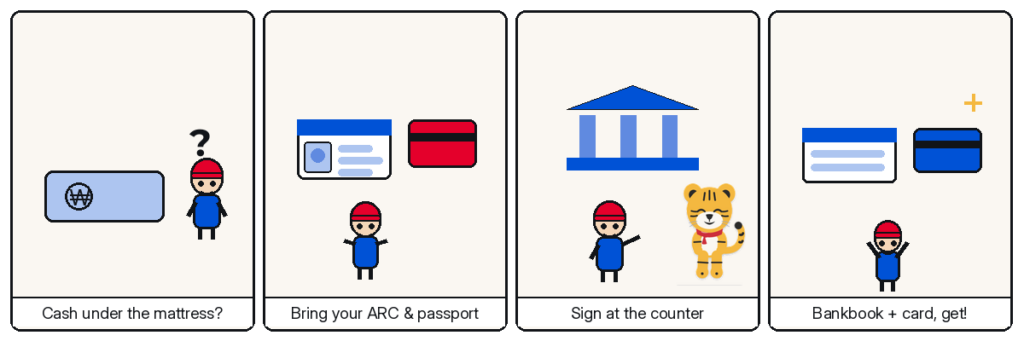
Korean banking runs on identity verification, and for foreigners that means two things. First, your ARC — without it, account opening in 2026 is realistically off the table (→ ARC guide). Second, a Korean phone number registered in your own name: app-based banks verify you through your mobile carrier, and a data-only eSIM or a prepaid SIM under someone else’s name fails that check (→ SIM & eSIM guide). The working order is: ARC → phone → bank.
Path A: Open It in an App (Easiest in 2026)
Toss Bank built the smoothest foreigner flow: download Toss, photograph your ARC, verify, done — no branch, no queue. The account arrives as a limited account (foreigners get a ₩300,000/day transfer cap), but here’s the killer feature: you can lift the cap inside the app by photographing proof documents; review takes 2–3 business days and unlocks limits in the tens of millions of won. At traditional banks, that same upgrade means a branch visit.
KB Kookmin (KB Star Banking) officially supports remote opening for foreigners 19+, with real conditions: ARC (a passport alone won’t do), a Korean-carrier phone in your own name — foreign carriers and prepaid SIMs are rejected — and a face-verification step.
Kakao Bank hasn’t joined yet: as of mid-2026 it still doesn’t open accounts for foreigners, though it has announced plans to launch them during 2026. Until then, Toss Bank and KB are your app routes — we’ll update this guide when Kakao goes live.
Path B: The Branch Visit
Still the default for many, and unavoidable for some setups. Bring more than you think you need: passport, ARC, and proof of purpose — an employment certificate or contract if you work, an enrollment certificate if you study — plus, occasionally, an entry/exit record. Banks tightened document checks under anti-fraud rules, and the call center’s “just bring your ARC” often loses to the branch’s longer list.
The unwritten rule that matters most: the branch you choose changes the outcome. Branches in foreigner-dense areas (Itaewon, Hongdae, university districts, Ansan) and banks’ global desks process foreigner accounts daily; a suburban branch may simply refuse out of unfamiliarity. Call ahead, confirm the document list, and if refused — try another branch before giving up on the bank.
Before you leave the counter, do two things: get your check card (debit card) issued, and have staff set up mobile banking and your certificate on your phone. Doing it later alone is the single most common regret.
The “Limited Account” Surprise
Whatever route you take, your shiny new account starts life as a 한도계좌 (limited account): electronic transfers capped around ₩300,000 a day, larger sums only at the counter. It’s not personal — it’s Korea’s anti-voice-phishing regime, applied to everyone without transaction history. Upgrading means showing the bank a reason to trust the account: an employment certificate, salary deposits landing monthly, even utility or phone-bill autopay. Employees usually shed the limits fast; if you’re between statuses, expect to live with the caps a while.
One Account per 20 Business Days
Korea limits new demand-deposit accounts to one per 20 business days across the entire banking industry. Open a Toss account today and the branch will turn you away until the clock resets. So sequence deliberately: open the account you need most first — usually the one your employer or school prefers — and add the second a month later.
After the Account: Plug It In
Route your salary in, set your NHIS premiums to autopay, and connect the account to Toss for transfers and tracking (→ 12 essential apps). Deposits are protected up to ₩100 million per person per bank — the same guarantee Koreans get.
Sending Money Home
Korean accounts can remit abroad, and the app banks have made it dramatically cheaper than the old counter ritual — but limits, documentation and the “designated foreign-exchange bank” rule deserve their own space. We cover every option — apps, banks, fees and the annual limit — in our complete guide to sending money from Korea.
Common Problems
“The branch refused me.” Nine times out of ten it’s documents or an inexperienced branch. Ask exactly what’s missing, then try a foreigner-heavy branch or the bank’s global desk — same bank, different answer.
“I need a bank account to get a phone, and a phone to get a bank account.” The classic loop. Break it in one of two ways: open at a branch first (a Korean phone often isn’t required in person), or get a cheap MVNO plan in your name first and then open in an app (→ SIM guide).
“My transfer limit is uselessly small.” That’s the limited account. Submit proof through the app (Toss) or at the branch; once salary starts landing, most banks relax quickly.
FAQ
Can I open an account before getting my ARC? Realistically no in 2026 — banks want the ARC. Tourists and sub-90-day visitors are effectively outside the system; plan around cards and cash until residency paperwork lands.
Which bank is “best”? The one whose nearby branch handles foreigners well, plus one app bank. A common combo: a big-four account (KB, Shinhan, Woori, Hana) for salary, Toss Bank for daily life.
Is online opening really possible for foreigners? Yes — that’s the 2026 change. Toss Bank and KB’s app both work with an ARC and a Korean phone in your name; Kakao Bank has announced its foreigner accounts are coming during 2026.
Does opening an account cost anything? No — no fees, no minimum balance for a basic account.
Is my money safe in a Korean bank? Yes: deposit insurance covers up to ₩100 million per person per bank, app banks included.
Official Resources
- Toss Bank, Kakao Bank, KB Star Banking — official apps on the App Store / Google Play
- KB Kookmin Bank: https://www.kbstar.com · Kakao Bank: https://www.kakaobank.com
- Need the prerequisites first? → ARC guide · SIM & eSIM guide · browse all guides