
Last updated: July 2026
Somewhere in Seoul today, a tenant just handed their landlord a deposit of roughly ₩217,000,000 — about the average for a one-room as of mid-2026 — and will pay ₩0 in monthly rent for two years, getting every won back at the end. That’s jeonse — insane-sounding, but normal here.
Here’s the reassuring part: you don’t need to do anything like that in your first week — or your first month. Renting here has its own vocabulary, its own paperwork, and one genuinely scary failure mode: deposit fraud. This guide covers the system, short-term options while you settle, and the three steps that protect your deposit on move-in day.
TL;DR
- Jeonse = a huge, fully refundable deposit and near-₩0 monthly rent. Wolse = a smaller deposit plus monthly rent (what most newcomers use). Banjeonse = in between.
- For your first 90 days, rent short-term — goshiwon, co-living, 33m2, Enkostay, or a registered Airbnb. Don’t rush into a 2-year lease.
- Protect your deposit with the Day-One Trio: move in → file your residence-change report (a foreigner’s version of 전입신고) within 15 days → get the fixed-date stamp (확정일자). Add the lease report within 30 days.
- Jeonse is a real bargain with real risk (깡통전세 / deposit fraud). Pull the property register yourself and use the Ansim Jeonse app.
- Stuck or scammed? Call 1345 (immigration, multilingual) or 132 (free legal aid).
The Korean Rental System: Jeonse, Wolse, and Banjeonse
Three words cover almost every lease you’ll see.
Jeonse (전세) is the famous one: you pay a large lump-sum deposit — a big share of the home’s value — and no monthly rent at all, getting it back in full when you leave. Wolse (월세) is a smaller deposit plus monthly rent — the usual choice if you’re settling in for a year or two. Banjeonse (반전세) splits the difference: a mid-size deposit and a lower monthly rent.
Converting a jeonse deposit into monthly rent has a legal rate ceiling: the Bank of Korea base rate + 2.0 percentage points. The BOK raised its base rate to 2.75% at its July 16, 2026 meeting, which puts the cap at 4.75% per year — the cap moves with the base rate, so re-check it after each BOK meeting. It applies to converting an existing jeonse or to increases at renewal, not to a brand-new contract’s market rate. Do the math yourself: a ₩100,000,000 deposit converted at the cap = ₩100,000,000 × 4.75% ÷ 12 ≈ ₩396,000 per month. If an offer runs well above that, push back.
What You Can Rent
Korean listings sort by property type, not bedroom count. The Seoul price bands below are wide on purpose: the market swings up to 2× by district and is far cheaper outside Seoul.
- One-room / two-room (원룸/투룸) — a studio or 1-bed in low-rise multi-unit buildings; appliances (fridge, washer, AC) vary, so check. Wolse runs roughly a ₩5,000,000–20,000,000 deposit plus ₩450,000–900,000/month; jeonse roughly ₩130–250 million.
- Officetel (오피스텔) — quasi-residential, with security, elevator, and often full furnishing; rents near a one-room’s, but maintenance fees run structurally higher.
- Villa (빌라) — low-rise, roomier and often cheaper, but weaker management and variable soundproofing/parking — and the type where jeonse fraud clusters, so be careful.
- Apartment (아파트) — top-tier management, security, and amenities; jeonse runs into the hundreds of millions, wolse high too. Best for families and long stays.
- Goshiwon / goshitel (고시원/고시텔) — a tiny private room with shared kitchen and shower, almost no deposit, immediate move-in. Roughly ₩250,000–550,000/month (₩400,000–500,000+ in Gangnam).
- Share house / co-living (셰어하우스/코리빙) — a private room plus shared space, furniture and utilities bundled, low deposit; some run in English. Roughly ₩700,000–1,300,000/month, deposit ~one to two months.
- Serviced residence (서비스드 레지던스) — hotel-meets-apartment, with cleaning and a front desk. Roughly ₩2,500,000–6,000,000+/month, for relocating professionals.
As a market reference, small Seoul units (33㎡ or under, at a ₩10,000,000 deposit) averaged roughly ₩700,000–900,000/month in early 2026, though published figures vary widely by sample.
Your First 90 Days: Rent Short First
The classic rookie mistake is signing a 2-year lease in week one — before you know the neighborhoods, your commute, or how to vet a landlord, and often before your Residence Card (ARC) and Korean bank account are sorted. Rent short-term first:
- Goshiwon — cheapest and fastest, near-zero deposit, move in today; English-friendly platform GOSHIWONS.com.
- Co-living and branded-rental brands — Mangrove, Episode, Remark VILL, Homes Company, WOOZOO, and Commontown offer furnished rooms with utilities and a low deposit, some with English support. Seoul units under 40㎡ run roughly ₩900,000–1,130,000/month (up to ~₩1,700,000 in Gangnam).
- 33m2 (삼삼엠투) — a busy short-term (weekly/monthly) rental platform; roughly ₩800,000–1,500,000/month.
- Enkostay (stay.enko.kr) — deposit-free monthly rentals aimed at foreigners, in Korean and English, with iOS and Android apps.
- Airbnb — registered listings only. Hosts must now register a business number, and since January 1, 2026 unregistered stays can’t be booked; any stay under 30 days is legal only in a registered unit. For 30-plus days, 33m2, Enkostay, or co-living are usually cheaper and safer.
Finding a Place
For the open market, the tools locals use:
- Zigbang (직방) and Dabang (다방) — the two biggest listing apps, heavy on one-rooms and officetels.
- Naver Real Estate (네이버부동산) — the standard integrated search.
- Peter Pan (피터팬의 좋은방 구하기, peterpanz.com) — direct-from-owner and brokered listings mixed; direct deals can save the agent fee, but watch for fake listings.
- Ziptoss (ziptoss.com/en) — an English-language brokerage for foreigners, with several Seoul branches.
- Enkostay — as above, foreigner-focused.
For an English-speaking agent, try foreigner-focused services, agencies in foreigner-heavy areas (university districts, Itaewon, Gangnam), or your company HR or school office; ordinary agencies vary in English. (For the everyday apps you’ll want — Naver Map, KakaoTalk, Karrot — see our 12 essential apps guide.)
The agent fee (중개보수) is capped by city ordinance — a small percentage of the “transaction amount” plus 10% VAT. For wolse, that amount = deposit + (monthly rent × 100) (× 70 if the total is under ₩50,000,000). Example: a ₩10,000,000 deposit + ₩700,000 rent = ₩80,000,000 → the 0.4% band, capped at ₩300,000 — so at most ₩300,000 + VAT. Agree the number before they show you places.
Signing the Contract
Once you’ve found a place, work through this in order.
1. Pull the property register yourself. The 등기부등본 (property register) is public — view it at the Supreme Court’s iros.go.kr, 24/7, no membership, for ₩700 (₩1,000 certified). Confirm the owner in the 갑구 section matches the person signing; scan the 을구 section for mortgages (근저당), seizures, and trust registrations (신탁등기); check the issue date is your contract day; and check the building ledger (건축물대장) for illegal-structure flags.
2. Match identities and pay carefully. The registered owner must be your landlord — check the ID. If a proxy signs, verify the power of attorney and the landlord’s seal certificate, video-call the landlord, and wire the deposit only to the registered owner’s account, never a proxy’s personal one.
3. Down payment, then balance. You’ll typically pay about 10% of the deposit at signing, the balance on move-in day when you get the keys. Bring your ARC.
4. Use the standard lease form. Use the government standard lease (주택임대차표준계약서). A licensed agent must give you a written confirmation-and-explanation statement, explain the property’s rights, and carry liability coverage (₩400M corporate / ₩200M individual).
5. Know your defaults. As of July 2026, the minimum term is 2 years (you can insist on two even if the paper says less), you have a one-time renewal right (2+2), and any increase at renewal is capped at 5%. (These “two laws” are under political debate but remain in force.)
6. Read the maintenance-fee line (관리비). Ask what’s bundled (general management, water, internet are common) versus billed separately (electricity and gas usually are). Small units advertising a flat fee of ₩100,000+/month must now itemize it in online listings — demand the breakdown before signing.
If your deposit tops ₩10,000,000, you can also view the landlord’s unpaid-national-tax record without their consent once you’ve signed — though only up until your move-in date (before signing, it needs their consent) — a fast way to spot a landlord in trouble.
Protect Your Deposit: The Day-One Trio
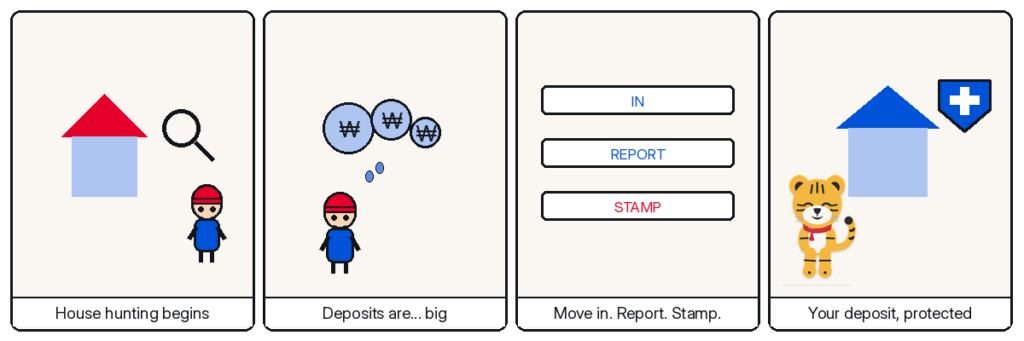
This is the most important section here. On move-in day, three steps turn you from “person who wired a stranger a fortune” into “legally protected tenant.”
1. Move in (take possession). Physically occupy the home and hold the keys.
2. File your residence-change report. For a foreigner, the report of change of residence (체류지 변경신고) legally substitutes for a Korean’s 전입신고. File it within 15 days of moving — at your new district office, an immigration office, or online via HiKorea (hikorea.go.kr); miss the deadline and you risk a fine up to ₩1,000,000. Move-in plus this report gives you opposing power (대항력) — the right to stay for your full lease term even if the property is sold or auctioned — effective at 0:00 the next day (a “same-day” reform is pending in the National Assembly but is not law as of July 2026, so file the moment you move).
3. Get the fixed-date stamp (확정일자). This dated stamp on your contract, with the two steps above, gives you priority repayment (우선변제권): in an auction you’re paid ahead of junior creditors. Get it at a district office, court, or registry for ₩600, or online at iros.go.kr for ₩500 — foreigners can use an ARC (no nationality bar in practice, though confirm at the counter).
Two more layers:
- Lease report (전월세 신고제): if the deposit tops ₩60,000,000 or monthly rent tops ₩300,000, report the contract within 30 days. Late filing has drawn fines since June 2025 — and it auto-assigns your fixed date, doing double duty.
- HUG deposit-return guarantee (jeonse and banjeonse): insures your deposit’s return. Eligible if the jeonse-to-value ratio is ≤90%, the deposit is within ₩700M (metro) / ₩500M (non-metro), the title is clean, and your opposing power and fixed date are set; the premium runs roughly 0.097–0.211% a year. Apply via the Ansim Jeonse app, KakaoBank or Toss, a partner bank, or HUG. Foreigners can generally enroll (submit your foreigner-registration certificate) but should confirm first at ☎1566-9009.
Jeonse: An Amazing Deal With Real Risks
Back to that ₩217-million question. Jeonse is a great deal if it goes right: zero monthly rent, a full refund, effectively free housing if you have the lump sum. The catch is when it doesn’t.
The nightmare is 깡통전세 (“underwater jeonse”) — when senior debt plus your deposit exceed what the property is worth, so an auction won’t return your money. A jeonse-to-value ratio above 80% is a widely used market red flag (a rule of thumb, not a legal line); HUG’s guarantee, a separate program, caps at a 90% ratio. Watch for a trust registration (신탁등기) on the title (the “owner” may not have authority to lease), heavy mortgages, inflated prices on new villas, double contracts, a landlord swapped in right before signing (a “straw owner,” 바지 집주인), and whole-building jeonse on villas.
Your best defensive tool is the Ansim Jeonse app (안심전세App) from HUG and the government: villa and officetel market values, landlord risk info (guarantee-accident history, tax arrears), and a checklist. A major upgrade is due September 2026.
The bottom line for newcomers: don’t do jeonse right after you arrive. The sums are enormous, the fraud risk is real, and you won’t yet know how to vet a property or landlord. Start with wolse or short-term, and consider jeonse only once you’re settled — and even then, lean on the register, the Ansim Jeonse app, and a HUG guarantee.
Common Problems
The landlord won’t return your deposit at move-out. File a lease-registration order (임차권등기명령) at the district court first — it preserves your opposing power and priority even after you move out — then pursue a payment order or deposit-return suit. Free advice at ☎132.
The agent wants more than the legal fee. It’s capped by city ordinance. Recompute the transaction amount yourself (deposit + rent × 100), hold them to the correct band plus 10% VAT, and get the confirmation-and-explanation statement in writing.
You’re not sure the “landlord” owns the place. Pull the register the same day at iros.go.kr, match the owner to the ID in front of you, and wire only to that owner’s account. If the identity or account feels off, stop.
You think you’re a jeonse-fraud victim. Korea’s special jeonse-fraud act runs through May 31, 2027, and an April 2026 re-amendment adds a minimum-guarantee scheme (the state covers at least one-third of the deposit), taking effect within six months of promulgation, with subordinate rules still being finalized. Call 132 and check the Ansim Jeonse app.
FAQ
Should I sign a jeonse in my first month? Generally, no. Rent wolse or short-term first — jeonse locks up an enormous sum (refundable, but not risk-free) before you know the market or how to vet a landlord.
Do foreigners really get the same deposit protection as Koreans? Yes, in principle. Your foreigner registration plus your residence-change report legally substitute for a Korean’s resident registration and move-in report — this is set out in the Immigration Act (Article 88-2) — giving you the same opposing power. (A 2019 Supreme Court ruling confirmed the same protection for overseas Koreans using a domestic-residence report.) File on time.
Can I break a lease early? If it renewed silently (묵시적 갱신), you can give notice any time, effective three months after the landlord receives it. Otherwise, leaving early usually means negotiating (often covering the cost of re-letting) — get any deal in writing.
How much is the agent’s fee? A legal maximum set by city ordinance — in Seoul, a fraction of a percent of the transaction amount (deposit + rent × 100), e.g. up to ₩300,000 + VAT on a ₩10,000,000 / ₩700,000 wolse.
Is Airbnb still fine for a month? Only registered listings. Since January 1, 2026, unregistered stays can’t be booked, and stays under 30 days are legal only in registered units — so for 30-plus days, 33m2, Enkostay, or co-living are usually the cheaper, safer call.
Official Resources
- Property register — iros.go.kr (Supreme Court Internet Registry): view ₩700 / certified copy ₩1,000, 24/7.
- HiKorea — hikorea.go.kr for the residence-change report; immigration hotline ☎1345 (multilingual). See also our emergency numbers guide.
- Seoul Global Center — ☎02-2075-4180, Mon–Fri 09:00–18:00, 10 languages, real-estate counseling; global.seoul.go.kr.
- Korea Legal Aid Corporation — ☎132, free legal advice for residents (foreigners included); runs the lease-dispute mediation committee.
- Dasan Call (Seoul) — ☎120, foreign-language help (English, Chinese, Japanese, Vietnamese, Mongolian), weekdays 09:00–18:00.
- HUG deposit-return guarantee — ☎1566-9009; apply via the Ansim Jeonse app.
- Easy Law (English) — easylaw.go.kr, “Housing Lease” pages in English.
Still getting oriented? Browse all our guides for banking, visas, and the rest of your first 90 days.