
Last verified: 2026-08-27 07:36 KST
Car sharing is how most foreign residents in Korea end up driving. No purchase, no insurance contract, no parking space — just an app and a car parked three streets away. The obstacles are not where newcomers expect them.
They are: what licence the operator will accept, whether three separate records agree on who you are, and a set of return rules that quietly decide your final bill.
The licence question comes first
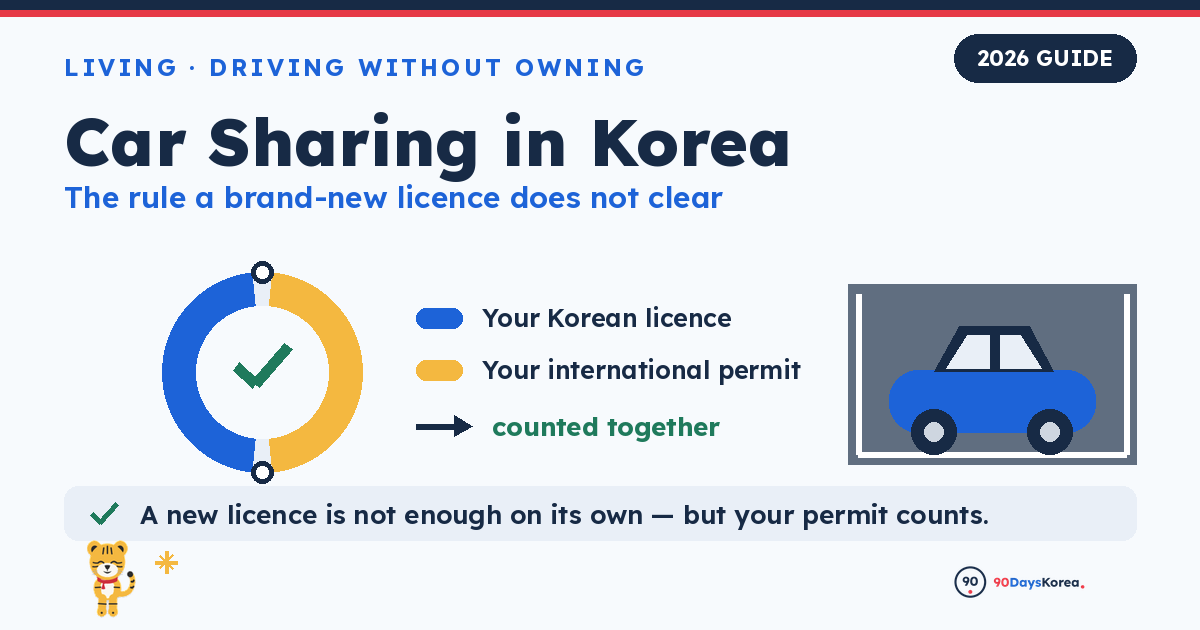
Before anything else, settle what you are allowed to drive on. A foreign licence alone does not permit driving in Korea — the Korea Road Traffic Authority states this directly. Your routes are an international driving permit within its validity, or a Korean licence obtained by exchange.
Two conditions from KoROAD decide whether the exchange trip works. Only a valid full licence can be exchanged: temporary, learner, provisional and probationary licences and permits cannot. And the embassy confirmation or Apostille must have been issued within one year of your application. Proxy applications are not accepted. Checked 2026-08-27. Full requirements in our licence exchange guide.
Operators set their own acceptance policy on top of the law, and the policies differ. Check what your chosen operator accepts before you assume an international permit is enough — that is a company decision, not a legal one, and the company’s answer is the one that matters at the reservation screen.
Three records that must all say the same thing
This is where sign-ups actually fail, and it is the same failure that breaks Korean banking and delivery apps.
Your licence, your phone line and your payment card must all be in the same name, spelled the same way. Korean identity verification checks the record your carrier holds — not the SIM in the handset — so an employer-provided line or a family plan fails even though the phone works.
Two documented traps sit under that. A data-only travel eSIM cannot receive an SMS code at all. And per the major carriers’ published subscriber terms, a postpaid line opened on a passport must be re-registered under your residence card within three months or it is suspended and terminated — so a line that verifies today may not exist next quarter. Checked 2026-08-27.
Repair sequence: immigration record first, carrier second, then retry. Our name verification guide covers it, and the line rules are in our SIM and eSIM guide.
It is not a rental counter
The mental model that causes trouble is the airport rental desk. Car sharing works differently in ways that cost money if you assume otherwise.
Socar operates through Socar Zones — designated parking spaces where you collect and return the car. The company states there are more than 5,000 nationwide, including zones near Jeju Airport, Gimpo Airport, Seoul Station, Busan Station, Daejeon Station and Gwangju Songjeong Station.
The rule that catches people: you must return the car to the zone you started from. Returning to a different zone requires booking either a delivery option or a one-way reservation up front. Deciding to drop the car somewhere else mid-trip is not a choice the system offers. Checked 2026-08-27.
Parking is cleaner than expected. Socar states that parking costs inside a Socar Zone are included in the rental price — no separate parking fee. But paid parking you use elsewhere during the trip is on you.
What the bill is made of
Three components, and only the first is the one people compare.
- Rental time, booked in blocks. Extending mid-trip is normally possible in the app, but not if someone has booked the car after you.
- Distance charge, billed per kilometre on top of the rental. This is the line that turns a cheap-looking day trip expensive. Some electric-vehicle products waive it, with charging included.
- Insurance product, chosen at booking. The excess you accept at booking is the amount you pay if something happens — and choosing the cheapest option is a bet, not a saving.
Fuel or charging is generally handled with a card in the car rather than out of pocket. Read your operator’s rule on the return fuel level before you set off, because the penalty for returning empty is a real line item.
Two operators, and a naming change worth knowing
Socar is the larger network and the one most foreign residents settle on.
G car is the other major service, and this is where guides written before 2025 mislead. Greencar rebranded its car-sharing service to G car, with the corporate entity unchanged — so English guides still calling it Greencar are describing the same company under an old brand. Its customer site now sits at greencar-gcar.co.kr, while the app store listing retains the older package name. If you are searching, try both terms.
Download links: Socar on Google Play · Socar on the App Store · G car on Google Play · G car on the App Store
Is the app usable in English?
Partly, and unevenly. Interface elements are often translated while the parts that matter most — insurance product descriptions, penalty terms, damage reporting — tend to stay Korean or read awkwardly in translation.
The practical approach is to read the Korean terms through translation before your first booking rather than during it. Socar publishes its terms and help documentation openly, and the insurance and penalty sections are worth ten minutes before you are standing next to a car with a scratch on it.
Before you drive off, and before you hand it back
The single habit that prevents most disputes: photograph the car before you move it. All four corners, the wheels, the interior, the dashboard showing fuel or charge level. Do the same when you return it. Timestamped photos settle arguments that a written note cannot.
Report any damage you find through the app before starting the trip, not after. Damage found at the start and reported is the previous driver’s; damage found at the end is yours.
When not to bother
For a single trip within a city, a taxi is usually cheaper once you count the distance charge and the return journey to the zone — see our taxi apps guide. For anywhere on the rail network, intercity trains beat driving on both cost and stress.
Car sharing earns its place for a specific shape of trip: multiple stops, somewhere transit does not reach, luggage or bulky purchases, or a group splitting the cost. If your Saturday is one destination on a train line, skip all of this — the options are in our day trips guide.
Sources
- Socar — service guide: Socar Zones, return rules, parking inclusion
- Socar — published terms of service
- Socar — help centre article on usage conditions
- G car — customer FAQ
- KoROAD — driving licence guidance
- KT — 5G subscriber terms (PDF): passport activation and three-month re-registration requirement, first source
- Second source for the three-month rule — reporting on the three carriers’ 5G standard terms submitted to the Korea Communications and Media Commission, confirming the same provision applies beyond a single carrier (14 August 2026)
Last verified: 2026-08-27 07:36 KST. Operator policies on foreign licences, insurance products and penalties change and differ between companies. The linked operator pages are the authority for their own service; KoROAD is the authority on licences.