
Last verified: 2026-08-27 14:57 KST
You have been in Korea a few weeks. Seoul is starting to feel familiar, and the question arrives: where do you go on a free Saturday when you don’t own a car and don’t want to book a hotel?
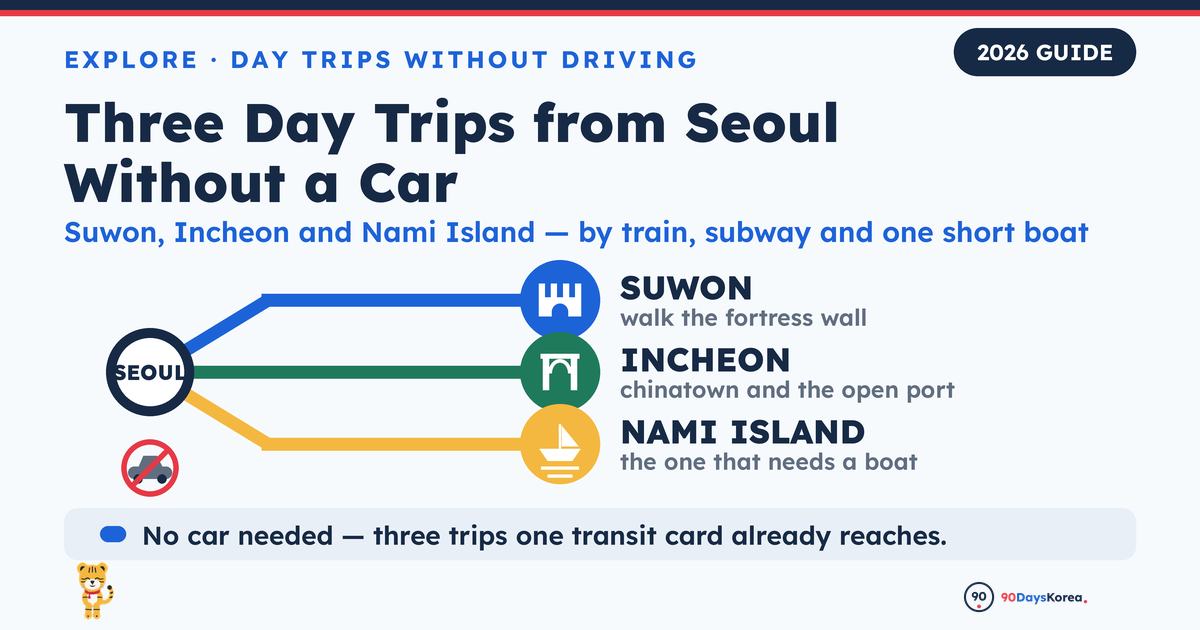
The honest answer is that you have more options than most guides admit. Three of the best day trips out of Seoul need nothing but a transit card and a train. This guide covers those three, what each actually costs, and the small operational details that ruin people’s days when they don’t know them.
If you would rather drive, we covered car sharing in Korea separately. Everything below assumes you are not driving.
One more thing worth knowing first: the way Seoul residents pay for transit changes on 1 September 2026. If you are reading this in late August, that change affects every trip below.
Before you go: the transit card change on 1 September 2026
Seoul’s Climate Card, the flat-rate unlimited pass, is being folded into a national scheme. From 1 September 2026 Seoul joins Modu Card — the programme reworked from K-Pass at the start of 2026 — under a Seoul-specific brand, Climate Companion Pass.
Three details matter more than the rebrand, and two of them are easy to get wrong:
- Your existing Climate Card does not die on 31 August. The last top-up date is 31 August, but a prepaid 30-day card stays usable to 29 September and a postpaid one to 30 September. Do not throw it away on 1 September.
- Short-term Climate Card passes are being kept. The scheme being retired is the 30-day and postpaid product, not the 1-to-7-day tourist passes — those continue, because Modu Card has no equivalent. If you are here briefly, the short pass is still the product for you.
- Already on K-Pass or Modu Card? Do nothing. Seoul residents already enrolled get the Seoul benefits applied automatically, with no reissue and no new application.
For day trips the change is a structural improvement. The old Climate Card only worked on journeys that both boarded and alighted inside Seoul — ride out to Suwon, Incheon or Gapyeong and it stopped helping you. Modu Card is a national refund scheme, so trips past the city limits are no longer outside the system. Our guide to Korean transit passes covers the wider landscape.
How the refund works is worth knowing, because it is not a flat rate. The system compares a percentage refund against a fixed-amount refund each month and automatically applies whichever leaves you better off. The percentage tier is around 20% for general users and 30% for the youth bracket. That means low-spending months still earn something, which the old flat-rate pass could not do.
Can foreign residents join?
Yes. Modu Card’s official conditions are that you are an adult aged 19 or over, hold an eligible card (existing K-Pass and Alttl Transport Card holders are accepted without reissue), and live in a participating local government — and the official page states in plain text that foreigners are eligible.
Seoul becomes the eighth participating local government on 1 September 2026, joining Gyeonggi, Incheon, Busan, Sejong, Gwangju, South Gyeongsang and Ulsan. If your residence card lists an address in any of those, you are in scope.
One thing people miss: you must register on the website or app to receive the refund. Simply holding the card does nothing. If your residency status raises a question the site does not answer, the Modu Card customer centre is 031-427-4415.
The headline Seoul-specific benefit is a widened youth bracket: the refund tier that covered ages 19 to 34 now runs to 39 for Seoul residents, so 35-to-39-year-olds move into the higher refund rate.
Trip 1: Suwon Hwaseong, a UNESCO World Heritage site you can walk for free
Suwon sits at the southern end of Subway Line 1. Hwaseong Fortress, built at the end of the eighteenth century, is a UNESCO World Heritage site, and here is the part almost nobody tells visitors.
The fortress walls themselves are free. Suwon Cultural Foundation lists the fortress as open-access, free of charge, open year-round with no closing day, and explicitly notes that night viewing is possible. You can walk several kilometres of eighteenth-century rampart, through gates and past watchtowers, and pay nothing at all.
What costs money is Hwaseong Haenggung, the walled palace complex inside.
Suwon: what you pay
- Hwaseong Fortress walls, free, year-round, no closing day
- Hwaseong Haenggung palace and Hwaryeongjeon, 2,000 won adult, 1,500 won youth and military, 1,000 won child
- Combined ticket (palace, Suwon Hwaseong Museum, Suwon Museum), 4,000 won adult
- Hwaseong Trolley from Yeonmudae, 6,000 won adult
- Traditional archery, 3,000 won for ten arrows
Palace hours are 09:00 to 18:00, year-round, with last admission one hour before closing. Note that gap: arrive at 17:30 and you will be turned away.
The hanbok exemption
The official fee table lists an exemption for visitors wearing hanbok, including modernised hanbok. Hanbok rental shops cluster around the palace, and the rental plus free entry often works out as a better afternoon than the 2,000 won ticket alone.
One caution. The same table carries a “Korean nationals only” note against a separate block of exemptions, the age-based, veteran and Suwon-youth ones. The hanbok line sits in its own row without that note, which reads as applying to everyone, but the page does not spell it out. If you are planning around it, call the Haenggung ticket office at 031-5191-4677 first rather than assuming.
Night opening and the tourist office
Haenggung runs a night opening from 1 May to 1 November 2026, Fridays through Sundays including public holidays, 18:00 to 21:30 with last admission at 21:00. A lit Joseon palace on a warm evening is a genuinely different experience from the same courtyard at noon.
There is also a practical asset most first-time visitors walk straight past. The Suwon Comprehensive Tourist Information Centre sits near Exit 4 of Suwon Station, open 09:00 to 18:00, with interpretation available in English, Chinese and Japanese. If your Korean is still at the survival stage, start there rather than at the fortress.
Trip 2: Incheon, Chinatown, the open port district, and a monorail with a trap in it
Incheon Station is the northern terminus of Subway Line 1, which means one seat from central Seoul with no transfer. Step out and Chinatown is directly across the road, with the open port historic district and the fairytale village within walking distance. All of that is free to wander.
The paid attraction is the Wolmi Sea Train, a 6.1-kilometre elevated loop around Wolmido island run by Incheon Transit Corporation. Four stations, views over the harbour and the West Sea.
The Monday problem
The Wolmi Sea Train is closed every Monday. If Monday falls on a public holiday it runs as normal and takes the next non-holiday day off instead. This single fact accounts for a large share of wasted trips to Wolmido, because visitors assume a public attraction runs seven days.
Incheon: hours and fares
Peak season is April to October. Fridays, Saturdays, Sundays and public holidays it runs 10:00 to 19:00; Tuesday to Thursday, 10:00 to 18:00. Off-season, November to March, it runs 10:00 to 18:00 daily except Mondays.
Watch the last departure. On an 18:00 closing day the final train leaves Wolmibada Station around 17:10 to 17:15; on a 19:00 closing day, around 18:10 to 18:15. Arriving at 17:45 on a weekday means you have missed it.
| Fare category | Adult | Senior / Youth | Child |
|---|---|---|---|
| General, weekday | 11,000 won | 8,000 won | 7,000 won |
| General, weekend | 14,000 won | 10,000 won | 8,000 won |
| Incheon resident, any day | 8,000 won | 6,000 won | 5,000 won |
Two things follow from that table. Going on a Tuesday instead of a Saturday saves 3,000 won per adult. And if you live in Incheon, the resident rate is cheaper than the general weekday rate on every day of the week.
The resident rate requires documentation proving local residence. The official list names the resident registration card, driver’s licence, youth card and resident registration abstract. It does not mention the Alien Registration Card. That is an omission rather than a refusal, but it is not something to assume at the ticket window. Call 032-450-7600 in advance if you intend to claim it.
Re-boarding: do not buy twice
Your ticket allows one re-boarding on the same day. That turns the loop from a sightseeing ride into an actual transport link. Get off at Wolmi Park, walk the park, get back on. Beyond that, if you keep your ticket and produce a same-day receipt from a business inside the Wolmi Tourism Special Zone, you can board again on weekdays.
Trip 3: Nami Island, the one that needs a boat
Nami Island sits in the Bukhan River. Administratively it belongs to Chuncheon in Gangwon, but the pier you leave from is in Gapyeong, Gyeonggi, which is why every route guide sends you to Gapyeong.
Two rail options reach Gapyeong Station, and the choice matters more than it looks. Our guide to using your transit card outside Seoul explains the fare mechanics in more detail.
- Gyeongchun Line, part of the metropolitan subway network. Tap in with your transit card, no reservation, no ticket queue. Slower.
- ITX-Cheongchun, a semi-high-speed service on the same corridor. Faster, but it is a reserved-seat train and you need a ticket.
If you are travelling on a whim, take the Gyeongchun Line. Reserved trains fill up on autumn weekends, and a failed booking at the station is a worse start than twenty extra minutes on the local train.
From Gapyeong Station the pier is a short taxi ride; local bus 10-4 also serves it. Check the current routing in a Korean map app before you set out.
Nami Island: what you pay
Admission and the round-trip ferry are sold as a single ticket:
- General, 19,000 won
- Concession, 16,000 won (middle and high school students, holders of severe disability registration, national merit recipients, age 70 and over)
- Special concession, 13,000 won (36 months to elementary school age)
A motorboat entry with standard ferry return is sold separately at a higher rate. Groups of 20 or more general-admission visitors receive 10% off the total, applicable only on the standard ferry.
The island admits visitors 365 days a year. Enquiries: 031-580-8114.
Time your ticket purchase
The official fee table lists discounted brackets tied to when you buy: an early-bird rate for tickets purchased before 08:00 and boarding a pre-08:00 ferry, and a late rate for purchases after 18:31 from April to November, or after 18:01 from December to March. The published table does not state the discounted amounts, so confirm at the ticket office. The principle is worth knowing regardless. Arriving very early or very late changes what you pay, and the early boat also means an empty tree-lined avenue instead of a queue.
Comparing the three
| Suwon Hwaseong | Incheon Wolmido | Nami Island | |
|---|---|---|---|
| Getting there | Line 1, no transfer | Line 1, no transfer | Gyeongchun Line or ITX |
| Minimum entry cost | 0 won, walls only | 0 won, Chinatown only | 19,000 won |
| Main paid item | Palace, 2,000 won | Sea Train, 11,000 to 14,000 won | Included in admission |
| Closing day | None | Mondays | None |
| Best for | History on a budget | Food and harbour views | Forest walking |
If money is the constraint, Suwon wins outright: a UNESCO site, free walls, a 2,000 won palace. If you want to eat well and see water, Incheon. If you want trees and are willing to pay for them, Nami.
Three practical notes
Use a Korean map app. Naver Map and Kakao Map handle Korean public transit routing properly; international map apps are unreliable for it here. Both have English interfaces.
Check the calendar before the fare. Weekday versus weekend changes the Incheon fare by 3,000 won and changes whether the Sea Train runs at all. Monday is the day that catches people.
Register your card before you travel. If you are moving onto Modu Card from 1 September, the refund only applies once you have registered on the site or app. A trip taken before registration earns nothing back.
None of these three requires a car, a booking, or a full weekend. Pick the one that matches your budget, check the day of the week, and go.
Sources
Figures above were checked against a primary source and confirmed against a second, independent one.
- The 1 September 2026 transit change — Seoul becoming the eighth Modu Card participating local government, the youth bracket widening from 34 to 39, automatic application for existing K-Pass and Modu Card holders, and the last top-up on 31 August with prepaid cards usable to 29 September and postpaid to 30 September, from the Seoul Metropolitan Government’s own Q&A on the change / confirmed by Herald Business reporting the joint announcement by the Ministry of Land’s Metropolitan Transport Commission and Seoul, giving the same eight participating governments and the same end dates.
- Refund mechanics — the system automatically applying whichever of the percentage or fixed-amount refund is more favourable, at roughly 20% general and 30% youth / confirmed by two independent Korean outlets describing the same dual calculation.
- Short-term passes continuing — that the retirement covers the 30-day and postpaid Climate Card products while short-duration passes are retained, because Modu Card has no equivalent / confirmed by the Seoul Q&A above and an independent reference tracking the same rollout.
- Modu Card eligibility — the three conditions including the explicit statement that foreigners are eligible, and the requirement to register on the site or app to receive any refund. Note: on the verification date above the Modu Card site was unreachable from our connection, so we could not re-read it. Call 031-427-4415 to confirm your own case.
- Suwon fees and hours — free year-round access to the fortress walls, the Haenggung ticket at 2,000 won adult / 1,500 won youth and military / 1,000 won child, the 4,000 won combined ticket, the 6,000 won trolley and 3,000 won archery, 09:00 to 18:00 palace hours with last admission one hour before closing, the hanbok exemption and the May-to-November night opening, from Suwon Cultural Foundation, the operating body.
- Wolmi Sea Train — the 6.1 km loop, the Monday closure with its public-holiday substitution rule, seasonal hours, the full fare table — general weekday 11,000 / 8,000 / 7,000 won, general weekend 14,000 / 10,000 / 8,000 won and Incheon resident 8,000 / 6,000 / 5,000 won by adult, senior-youth and child — and the same-day re-boarding entitlement, from Incheon Transit Corporation, the operator.
- Nami Island — the 19,000 / 16,000 / 13,000 won combined admission and round-trip ferry rates, the 10% group discount and 365-day opening, from the operator’s published fee table.
What we could not verify. Two things are flagged rather than asserted. The hanbok exemption at Hwaseong Haenggung sits in a row without the “Korean nationals only” note that marks the age-based and veteran exemptions, which reads as applying to everyone — but the page does not say so outright, so call 031-5191-4677 before planning around it. And the Wolmi Sea Train’s resident discount lists acceptable documents without naming the Alien Registration Card; that is an omission rather than a refusal, so call 032-450-7600 rather than assuming at the window. We could not reach the Modu Card or Nami Island sites directly on this update, so those entries rest on the operators’ published figures plus independent confirmation.
Prices, hours and eligibility rules change. Confirm with the phone numbers above before travelling.