

Suwon, Incheon and Nami Island can be planned without renting a car, but include the onward journey from the station and any separate ticket. A transit card alone does not cover every rail service, attraction or ferry arrangement. The guide also describes Seoul’s September 2026 transit change as a past transition.
Plan one complete return journey
- Use your actual departure station. Check the route and destination branch for the chosen day, including transfers; a named rail line does not guarantee a direct trip from every origin.
- Plan the station-to-attraction leg. Include the walk, bus or taxi after reaching Suwon, Incheon or Gapyeong, and check how you will get back to the station.
- Separate transport and admission. Budget rail and local fares, plus any attraction ticket. ITX needs its own rail ticket; Nami’s ticket price is for admission; check on namisum.com what it covers, and budget travel to the pier separately.
- Check the operating day and last departure. Confirm the Sea Train’s holiday-shifted Monday closure and actual last train, or the palace’s relevant daytime/night schedule.
- Keep a backup. Check the weather, available return services and a nearby alternative before committing to a paid attraction or a late return.
Trip checklist added 14 October 2026. The specific Suwon and Sea Train operator details and KTO’s Nami general-admission listing were checked on that date. Complete transport fares, individual discounts, bookings and the Nami operator page were not verified.
Suwon, Incheon and Nami Island are options for a day outside Seoul without renting a car. Compare the route, admission costs and opening days below. Some journeys need a separate train or ferry ticket; a transit card alone will not cover every part of the day.
If you’d rather drive, car sharing in Korea has a separate guide. Everything below assumes you aren’t driving.
For these trips, distinguish ordinary transit-card payment from registered resident refunds. Short-term visitors should not budget for a resident subsidy.
Before you go: the transit card change on 1 September 2026
Seoul’s Climate Card, the flat-rate unlimited pass, has been folded into a national scheme. On 1 September 2026 Seoul joined Modu Card (the program reworked from K-Pass at the start of 2026) under a Seoul-specific brand, Climate Companion Pass.
Three details matter more than the rebrand, and two of them are easy to get wrong:
- The earlier 30-day Climate Card products ended in stages. The last top-up date was 31 August 2026; a prepaid 30-day card ran no later than 29 September 2026 and a postpaid one through 30 September 2026. For travel after those dates, check the current card product and its accepted services.
- Short-term Climate Card passes are kept. The products retired are the 30-day and postpaid cards, not the 1-to-7-day tourist passes; they continue, but their coverage does not include these day-trip destinations. Check the route before buying one.
- Already on K-Pass or Modu Card? Do nothing. Seoul residents already enrolled get the Seoul benefits applied automatically, with no reissue and no new application.
Pass coverage depends on the listed lines, stations and transport services; the earlier Climate Card boundary was not simply every trip with both ends inside Seoul. A refund scheme is a separate eligibility question from card acceptance. Check the current route and registered product in the transit-pass guide.
How the refund works is worth knowing, because it is not a flat rate. The system compares a percentage refund against a fixed-amount refund each month and automatically applies whichever leaves you better off. The percentage tier is around 20% for general users and 30% for the youth bracket. That means low-spending months still earn something, which the old flat-rate pass could not do.
Can foreign residents join?
Yes. Modu Card’s official conditions are that you are an adult aged 19 or over, hold an eligible card (existing K-Pass and Alttl Transport Card holders are accepted without reissue), and live in a participating local government, and the official page states in plain text that foreigners are eligible.
Seoul’s specific benefits depend on Seoul residence. For another municipality, confirm the current local scheme, eligible card and registration with the responsible provider. An address alone does not establish that every fare or journey qualifies for a refund.
Confirm the issuer’s and K-Pass instructions for the actual product; prepaid cards have a separate issuer-registration step. See the transit-pass guide before budgeting a refund. Registration scope checked 14 October 2026.
The headline Seoul-specific benefit is a widened youth bracket: the refund tier that covered ages 19 to 34 now runs to 39 for Seoul residents, so 35-to-39-year-olds move into the higher refund rate.
Trip 1: Suwon Hwaseong, a UNESCO World Heritage site you can walk for free
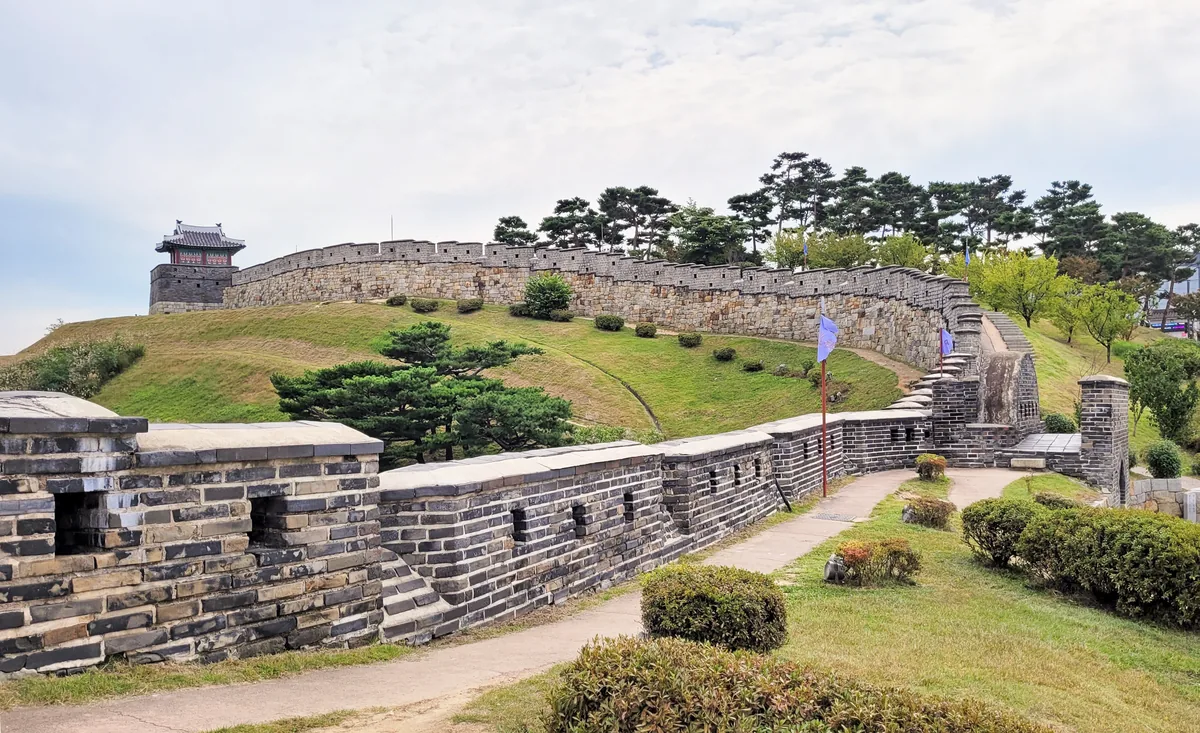
Suwon is served by Subway Line 1; check the train destination and any transfers from your own departure station. Hwaseong Fortress, built at the end of the eighteenth century, is a UNESCO World Heritage site.
The fortress walls themselves are free. Suwon Cultural Foundation lists the fortress as open-access, free of charge, open year-round with no closing day, and explicitly notes that night viewing is possible. You can walk several kilometers of eighteenth-century rampart, through gates and past watchtowers, and pay nothing at all.
What costs money is Hwaseong Haenggung, the walled palace complex inside.
Suwon: what you pay
- Hwaseong Fortress walls, free, year-round, no closing day
- Hwaseong Haenggung palace and Hwaryeongjeon, 2,000 won adult, 1,500 won youth and military, 1,000 won child
- Combined ticket (palace, Suwon Hwaseong Museum, Suwon Museum), 4,000 won adult
- Hwaseong Trolley from Yeonmudae, 6,000 won adult
- Traditional archery, 3,000 won for ten arrows
Palace hours are 09:00 to 18:00, year-round, with last admission one hour before closing. Note that gap: arrive at 17:30 and you will be turned away.
Suwon’s listed wall access, palace fee and basic hours were checked 14 October 2026 at the official visitor guide (Korean). Check the notice for your particular night visit; this review does not establish the details of any special extended-opening event.
The hanbok exemption
The official table includes a hanbok admission exemption. Confirm its applicable conditions and the rental price before choosing it; hiring clothes can cost more than simply buying a palace ticket.
The Suwon Cultural Foundation lists a hanbok exemption, including modernized hanbok, in its own row. The Suwon-resident restriction appears with the named volunteer and youth concessions, not as a general nationality rule. The page doesn’t spell out every foreign visitor’s eligibility or accepted evidence. Confirm those details with the Haenggung ticket office at 031-5191-4677 before budgeting a discount.
Night opening and the tourist office
Haenggung runs a night opening from 1 May to 1 November 2026, Fridays through Sundays including public holidays, 18:00 to 21:30 with last admission at 21:00. A lit Joseon palace on a warm evening is a different experience from the same courtyard at noon.
There’s also a useful stop by the station. The Suwon Comprehensive Tourist Information Center sits near Exit 4 of Suwon Station, open 09:00 to 18:00, with interpretation available in English, Chinese and Japanese. If your Korean is still at the survival stage, start there rather than at the fortress.
Trip 2: Incheon Chinatown, the open port district and Wolmi Sea Train
Incheon Station is on Line 1. Check the correct destination branch and any transfers from your departure station. Chinatown is across the road from the station, with the open-port district nearby; walking around those public areas is separate from buying a Sea Train ticket.
The paid attraction is the Wolmi Sea Train, a 6.1-kilometer elevated loop around Wolmido island run by Incheon Transit Corporation. Four stations, views over the harbor and the West Sea.
The Monday problem
The Sea Train normally closes on Monday. If Monday is a public holiday, the operator says it runs that day and closes on the first following non-public-holiday day. Check the current notice before traveling. Operator rule checked 14 October 2026.
Incheon: hours and fares
Peak season is April to October. Fridays, Saturdays, Sundays and public holidays it runs 10:00 to 19:00; Tuesday to Thursday, 10:00 to 18:00. Off-season, November to March, it runs 10:00 to 18:00 daily except Mondays.
Watch the last departure. On an 18:00 closing day the final train leaves Wolmibada Station around 17:10 to 17:15; on a 19:00 closing day, around 18:10 to 18:15. On an 18:00 closing day, arriving at 17:45 is after the listed last departure from Wolmibada Station.
| Fare category | Adult | Senior / Youth | Child |
|---|---|---|---|
| General, weekday | 11,000 won | 8,000 won | 7,000 won |
| General, weekend | 14,000 won | 10,000 won | 8,000 won |
| Incheon resident, any day | 8,000 won | 6,000 won | 5,000 won |
Sea Train’s Korean fare, seasonal-hour, early-last-departure and re-boarding rules were checked 14 October 2026 at Incheon Transit Corporation (Korean). The attraction ticket is separate from getting to Incheon.
Two things follow from that table. Going on a Tuesday instead of a Saturday saves 3,000 won per adult. And if you live in Incheon, the resident rate is cheaper than the general weekday rate on every day of the week.
The resident rate requires documentation proving local residence. The official list names the resident registration card, driver’s license, youth card and resident registration abstract. It does not mention the Alien Registration Card. That is an omission rather than a refusal, but it is not something to assume at the ticket window. Call 032-450-7600 in advance if you intend to claim it.
Re-boarding: do not buy twice
Your ticket allows one re-boarding on the same day. That turns the loop from a sightseeing ride into an actual transport link. Get off at Wolmi Park, walk the park, get back on. Beyond that, if you keep your ticket and produce a same-day receipt from a business inside the Wolmi Tourism Special Zone, you can board again on weekdays.
Trip 3: Nami Island, the one that needs a boat
Nami Island sits in the Bukhan River. Administratively it belongs to Chuncheon in Gangwon, but the pier you leave from is in Gapyeong, Gyeonggi, which is why every route guide sends you to Gapyeong.
Two rail options reach Gapyeong Station, and the choice matters more than it looks. The guide to using your transit card outside Seoul explains the fare mechanics in more detail.
- Gyeongchun Line, part of the metropolitan subway network. Tap in with your transit card, no reservation, no ticket queue. Slower.
- ITX-Cheongchun, a semi-high-speed service on the same corridor. Faster, but it is a reserved-seat train and you need a ticket.
Choose between the metropolitan line and ITX using the actual timetable and availability. If you choose ITX, buy the required rail ticket and check your return departure; do not assume that every station or train has the same journey-time difference.
From Gapyeong Station the pier is a short taxi ride; local bus 10-4 also serves it. Check the current routing in a Korean map app before you set out.
Nami Island: what you pay
What the admission ticket costs:
- General admission: 19,000 won in the KTO listing, checked 14 October 2026.
- Concessions and special products: confirm the current conditions and total with the operator before buying; this update did not verify who qualifies.
Check any motorboat, group or discounted product directly with the operator before paying. The general admission figure above does not establish those separate conditions; this review could not read the operator’s fee page.
The island admits visitors 365 days a year. Enquiries: 031-580-8114.
Time your ticket purchase
If an early, late or group discount would affect your choice, confirm the current amount and qualifying ferry with the ticket office before arranging transport. This update did not verify those discount brackets. An early departure also requires checking the station-to-pier journey and return services.
Comparing the three
| Suwon Hwaseong | Incheon: Chinatown + optional Sea Train | Nami Island | |
|---|---|---|---|
| Rail leg: check your origin | Line 1 to Suwon | Line 1 to Incheon | Gyeongchun Line or a separate ITX ticket |
| After the station | Walk, local bus or taxi to the fortress/palace | Walk to Chinatown; check onward transport to Wolmido | Bus or taxi to the pier, then ferry |
| Minimum entry cost | 0 won, walls only | 0 won, Chinatown only | 19,000 won |
| Main paid item | Palace, 2,000 won | Sea Train, 11,000 to 14,000 won | General admission 19,000 won; rail/local transport extra |
| Closing day | None | Sea Train: Mondays; if Monday is a public holiday, the next non-holiday | None |
| Best for | History on a budget | Food and harbor views | Forest walking |
If money is the constraint, Suwon wins outright: a UNESCO site, free walls, a 2,000 won palace. If you want to eat well and see water, Incheon. If you want trees and are willing to pay for them, Nami.
Practical notes
Use a Korean map app. Naver Map and Kakao Map handle Korean public transit routing properly; international map apps are unreliable for it here. Both have English interfaces.
Check the calendar before the fare. Weekday versus weekend changes the Incheon fare by 3,000 won and changes whether the Sea Train runs at all. Monday is the day that catches people.
Register your card before you travel. If you use Modu Card, the refund only applies once you have registered on the site or app. A trip taken before registration earns nothing back.
Check the actual services and tickets you need; ITX seats and some products may require booking. Pick the one that matches your budget and check the day of the week.
Source review. On September 24, 2026 an AI-assisted check compared the 31 August last top-up date and a prepaid 30-day card usable to 29 September against the Seoul Metropolitan Government, and confirmed the official sources linked in this guide still resolve to the same pages. Report corrections to [email protected].
Frequently asked questions
Is Hwaseong Fortress in Suwon free to visit?
Yes. Suwon Cultural Foundation lists the fortress walls as free, open year-round with no closing day. Hwaseong Haenggung palace inside costs 2,000 won for adults and is open 09:00 to 18:00, with last admission one hour before closing.
Is the Wolmi Sea Train in Incheon open on Mondays?
The Sea Train normally closes on Monday. If Monday is a public holiday, it operates that day and closes on the first following non-holiday instead.
How much does a Nami Island ticket cost?
KTO’s listing gives 19,000 won for general admission. Check namisum.com (Korean) for whether the ferry is included. Transport to the pier is extra. Confirm current concession eligibility, special products and operating notices with the operator; these were not verified in this update.
Related guides
- Winter Trips from Seoul: Snow, Skiing & Slow Weekends
- Naengmyeon: The Cold Noodle Guide Nobody Gives Foreigners
- Gangneung vs Busan: Your First Trip Outside Seoul
- Browse all 90DaysKorea guides
Sources
Links marked (Korean) open Korean-language pages; your browser’s built-in translation can show most of them in English.
The specific 14 October 2026 source checks are described below; other information retains its earlier check date. The current review does not certify every discount, refund, event or complete transport cost.
- The 1 September 2026 transit change: Seoul becoming the eighth Modu Card participating local government, the youth bracket widening from 34 to 39, automatic application for existing K-Pass and Modu Card holders, and the last top-up on 31 August with prepaid cards usable to 29 September and postpaid to 30 September, from the Seoul Metropolitan Government’s own Q&A on the change (Korean) / confirmed by Herald Business reporting the joint announcement by the Ministry of Land’s Metropolitan Transport Commission and Seoul, giving the same eight participating governments and the same end dates.
- Refund mechanics: the system automatically applying whichever of the percentage or fixed-amount refund is more favorable, at roughly 20% general and 30% youth / confirmed by two independent Korean outlets describing the same dual calculation.
- Short-term passes continuing: that the retirement covers the 30-day and postpaid Climate Card products while short-duration passes are retained, because Modu Card has no equivalent / confirmed by the Seoul Q&A above and an independent reference tracking the same rollout.
- Modu Card eligibility, the three conditions including the explicit statement that foreigners are eligible, and the requirement to register on the site or app to receive any refund. Note: on the verification date above the Modu Card site couldn’t be reached from the connection used for the check, so it wasn’t reread. Call 031-427-4415 to confirm your own case.
- Suwon fees and hours, free year-round access to the fortress walls, the Haenggung ticket at 2,000 won adult / 1,500 won youth and military / 1,000 won child, the 4,000 won combined ticket, the 6,000 won trolley and 3,000 won archery, 09:00 to 18:00 palace hours with last admission one hour before closing, the hanbok exemption and the May-to-November night opening, from Suwon Cultural Foundation (Korean), the operating body.
- Wolmi Sea Train: the 6.1 km loop, the Monday closure with its public-holiday substitution rule, seasonal hours, the full fare table, general weekday 11,000 / 8,000 / 7,000 won, general weekend 14,000 / 10,000 / 8,000 won and Incheon resident 8,000 / 6,000 / 5,000 won by adult, senior-youth and child, and the same-day re-boarding entitlement, from Incheon Transit Corporation (Korean), the operator.
- Nami Island: KTO’s current listing gives 19,000 won general admission, checked 14 October 2026; it does not say whether the ferry is included. The operator fee-page read returned 403 in this review; group discounts and concession qualifications were not confirmed.
Verification limits. Confirm the hanbok-exemption conditions and the documents accepted for a Sea Train resident discount before budgeting either. Current K-Pass eligibility and the Nami operator’s discount conditions were not tested here. Nami’s general admission figure comes from KTO’s listing; it is not a direct reread of the unavailable operator fee page.
Prices, hours and eligibility rules change. Confirm with the phone numbers above before traveling.