

Last updated: July 2026
You’ve landed at Incheon after a long flight — now what? There are three real ways into Seoul, and the right one depends on your luggage, your landing time, and where you’re staying. Here’s the honest comparison, with 2026 prices.
TL;DR
- Cheapest: All-stop AREX train — about ₩4,750–5,050 with a transit card, roughly an hour to Seoul Station
- Fastest & guaranteed seat: AREX Express — ₩13,000, non-stop to Seoul Station in ~43 minutes
- Best with heavy luggage: Airport limousine bus — ₩16,000–18,000, stops near major hotel areas
- Door-to-door: Taxi — roughly ₩60,000–90,000+ plus toll; worth it for groups of 3–4 or late-night arrivals
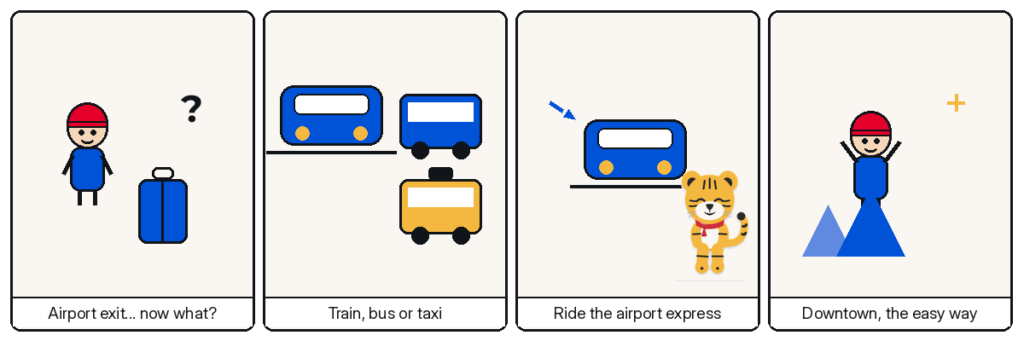
Option 1 — AREX All-Stop Train (Cheapest)
The commuter train runs from both terminals to Seoul Station in about an hour, stopping at 14 stations along the way — including transfer hubs like Hongik University, Gongdeok, Gimpo Airport and Digital Media City. With a transit card, the full ride costs about ₩4,750 from Terminal 1 and ₩5,050 from Terminal 2. Trains come every 5–10 minutes.
The catch: it’s a real commuter train — regular subway-style seating, so at rush hour you may stand with your suitcases. And if your accommodation isn’t near a station on the line (or an easy transfer), hauling luggage through subway stairs can erase the savings.
Tip: grab a T-money transit card before you ride — some airport SIM packages even include one as the SIM holder (→ see our Korea SIM & eSIM guide).
Option 2 — AREX Express Train (Fastest, Reserved Seat)
The orange Express runs non-stop between Incheon Airport and Seoul Station: about 43 minutes from Terminal 1, departures every 20–40 minutes, with an assigned seat, luggage space and onboard Wi-Fi. The standard adult fare is ₩13,000, and booking online in advance (official AREX app or major travel platforms) is typically a couple of thousand won cheaper than the counter price.
Best for: solo travelers or couples heading somewhere near Seoul Station (or transferring to KTX trains), anyone who wants a guaranteed seat after a long flight.
Option 3 — Airport Limousine Bus (Best Luggage-to-Effort Ratio)
Buses leave from clearly marked stops right outside arrivals (Terminal 1: outside the 1F doors; Terminal 2: B1 transport center), run every 15–30 minutes on major routes, and stop near big hotel clusters — Myeongdong, Hongdae, Gangnam, Jamsil and more. Seoul routes cost about ₩16,000–18,000, and the ride takes 60–80 minutes depending on traffic. Staff load your luggage; you nap.
Pay at the ticket booths/machines at the curb, or tap T-money or a credit card on most routes.
Best for: 1–2 people with big suitcases staying near a bus stop; anyone who hates transfers.
Option 4 — Taxi (Door-to-Door)
Follow the taxi signs at arrivals. Expect roughly ₩60,000–90,000+ to central Seoul depending on district and traffic, plus the airport expressway toll (paid by the passenger). Late-night surcharges apply after 10 pm.
Practical tips: use the Kakao T app to call a cab — you set the destination in-app (no Korean conversation needed) and see a fare estimate before you commit. “International Taxi” services offer flat-rate bookings with English-speaking drivers at a premium. For 3–4 people splitting the fare, a taxi can rival the bus per person.
Landing After Midnight?
Trains and most limousine buses wind down late in the evening. Past roughly midnight, your realistic options are a taxi, a pre-booked pickup, or the limited late-night airport bus routes — check the Incheon Airport website for current N-route schedules before you fly. If you land past midnight, budget for a taxi rather than gambling on a departure board at 1 a.m.
Which One Should You Take?
- Solo, light luggage, hotel near a subway line → All-stop train
- Heading to Seoul Station area, want a guaranteed seat → Express train
- Heavy luggage, hotel in a major district → Limousine bus
- Group of 3–4, small kids, or a post-midnight arrival → Taxi / pre-booked pickup
Common Problems
“Which terminal am I at?” Check your baggage claim signs — Terminal 2 serves Korean Air and its partners; most other airlines use Terminal 1. The train and buses serve both.
“Can I pay with a foreign credit card?” Train ticket machines and bus booths generally take cards; taxis take cards too. Still, a little cash in week one never hurts.
“Rush hour?” Roads into Seoul crawl at 7–9 a.m. and 6–8 p.m. — that’s when the train (either kind) beats the bus and taxi decisively.
“Heading back to the airport later?” Reverse the same math and add buffer for traffic; the Express train is the most predictable option for tight departure times.
FAQ
Is the Express train worth double the all-stop fare?
If you value a guaranteed seat after a 10-hour flight, yes. If you’re counting every won and traveling light, the all-stop train wins.
Do the buses have Wi-Fi?
Many do, but don’t bet your arrival messages on it — sort your eSIM before flying (→ Korea SIM & eSIM guide).
Is there luggage storage at Seoul Station?
Yes — lockers and luggage services operate there if you arrive before check-in time.
What about Gimpo Airport?
Gimpo is much closer to the city — subway lines 5/9 or a short taxi; most of this guide’s math shrinks accordingly.
I’m moving here, not visiting — what’s next after I get to the city?
Your 90-day clock starts at entry: begin with our Residence Card (ARC) guide, then browse all settlement guides.
Official Resources
- AREX (schedules, fares, Express booking): https://www.airportrailroad.com
- Incheon Airport (bus routes, late-night info): https://www.airport.kr