
Last updated: July 2026
Your T-money card charges you full fare, every single tap. That's fine for a light rider — but if you commute, Korea will literally hand money back to you through two government schemes. And 2026 is the year to pay attention: one pass retired this summer, and its replacement arrives on 1 September. Here's the comparison we promised in our T-money guide.
TL;DR
- T-money — the pay-as-you-go base card everyone needs. No refunds, no requirements.
- K-pass — the resident's money-saver: 20–53% of your fares refunded every month (15+ rides). Needs an ARC. Spend past a monthly threshold and the excess comes back 100%, applied automatically.
- Climate Card — Seoul's 30-day pass took its last charge on 31 July 2026. From 1 September 2026 its benefits move to Modeuui Card (Climate Companion Pass), reached through K-pass. The 1–7 day short-term passes live on.
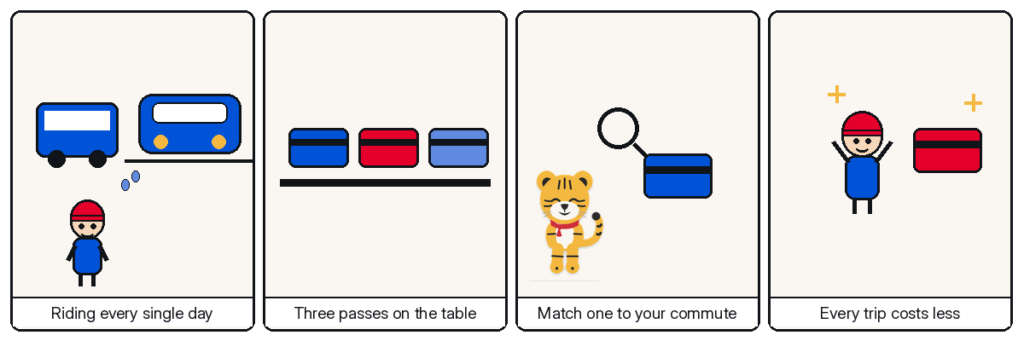
- Rule of thumb: no ARC yet → T-money. ARC + 15 rides a month → K-pass. Touring Seoul hard for a few days → short-term Climate Card.
The Baseline: T-money
Pay per ride, distance-based fares, free transfers within the time window — the card everything else builds on. It asks nothing of you (no ID, no registration) and gives nothing back beyond the transfer discount. If you ride fewer than 15 times a month, stop reading: T-money alone is your answer (→ full T-money guide).
K-pass: The Resident's Money-Saver
What it is. A nationwide scheme that refunds a slice of your transit spending every month, as long as you ride 15+ times: roughly 20% for general users, 30% for youth (ages 19–34), and up to 53% for low-income users, with boosted rates for multi-child families. Rides count up to 60 per month, and the refund lands the following month through your card company.
The 2026 upgrade. Since January 2026, K-pass runs a second formula nicknamed "Everyone's Card" (모두의 카드): whatever you spend on transit above a monthly threshold comes back 100%. In the capital area the threshold sits around ₩62,000 for the basic tier, and around ₩100,000 for a plus tier that also covers premium rides like GTX, the Sinbundang line and express buses. You don't choose between the two formulas — the system checks your month and applies whichever refunds more. Heavy commuters effectively get a fare cap.
How foreigners join. K-pass requires a resident registration number — for us, that means your foreign registration number on the ARC (→ ARC guide). Then get a K-pass partner card (a check/credit card from a partner bank, or a prepaid route like the Mobile T-money app), register it on the K-pass app or website, and ride. Your plain plastic T-money card does not qualify on its own.
Climate Card: Retired, and Renamed
What it was. Seoul's flat-rate unlimited pass: ₩62,000 for 30 days of unlimited subway and city buses inside Seoul (₩55,000 for ages 19–39; a bit more with bike-share added).
What changed. The prepaid 30-day pass took its last charge on 31 July 2026 and can be ridden through 29 August; the postpaid version ends 1 September. The replacement arrived under a different name than Seoul first announced. Seoul had trailed "Climate Card Plus," but after a month-long dispute with the national transport authority, a joint announcement on 30 July 2026 settled on Modeuui Card (Climate Companion Pass), launching 1 September 2026. Seoul joins that scheme as its eighth regional partner rather than merging two systems — the framing matters less than the practical result, which is that existing Climate Card benefits carry over. Three things Seoul secured in the negotiation: the youth refund band widens to ages 19–39, the veterans' discount extends to age 42, and Seoul's public bike share is linked in. Seoul's advice in the meantime is unchanged: join K-pass now — existing K-pass users get the added benefits automatically.
What survives. The short-term passes — 1, 2, 3, 5 and 7 days (₩5,000 up to ₩20,000) — stay, and they're the underrated option: no ARC, no registration, sold at station machines. One quirk: they start the day you charge them, so no pre-loading for tomorrow. If friends or family visit and plan a sightseeing marathon, this is their card — see our host's guide to visitors in Korea for the rest of that checklist. One caveat carried over from our T-money guide: on iPhone, the Climate Card means a physical card — mobile versions are Android-only.
So Which One Do You Get?
Just landed, no ARC yet — T-money, done. You can't join K-pass anyway, and overthinking transit in week one is wasted energy.
ARC in hand and riding to work or school most days — K-pass, immediately. It's a refund on taps you were making anyway; skipping it is donating money to the fare system.
Hosting visitors, or blitzing Seoul's sights for a few days — a short-term Climate Card beats everything on pure volume.
Seoul mega-commuter — K-pass now. From 1 September 2026 the Seoul-specific benefits arrive through Modeuui Card (Climate Companion Pass), automatically for existing K-pass users.
Common Problems
"I already charged a 30-day Climate Card — is it dead?" No, it runs until its own expiry. Recharging ended on 31 July 2026, and rides on an existing charge run through 29 August.
"Can K-pass refund my existing T-money card?" Not the basic plastic one. You need a card issued through a K-pass partner (or a K-pass-enabled prepaid setup like the Mobile T-money app), registered in the K-pass system.
"I rode 15+ times but no refund arrived." Refunds come the following month via your card company — and only for rides after your card was registered. Check the K-pass app's history to see what actually counted.
FAQ
Can tourists use K-pass?
No — it's tied to resident registration. Tourists ride on T-money and, for heavy Seoul days, the short-term Climate passes.
Does K-pass work outside Seoul?
Yes — it's a nationwide scheme covering subways and buses across participating regions (which is most of the country), with premium modes like GTX under the plus tier.
What doesn't K-pass cover?
Taxis and intercity trains like the KTX. It's a public-transit scheme, not a travel discount.
What is Modeuui Card (Climate Companion Pass)?
The scheme replacing Seoul's Climate Card from 1 September 2026. It is the national Everyone's Card programme with Seoul-specific benefits added on top — a widened youth band, an extended veterans' discount and public bike share. Existing K-pass users do not need to do anything to receive them.
Why do the "youth" ages differ between schemes?
Annoying but true, though it is being fixed: K-pass counted youth as 19–34 while the Climate Card used 19–39. From 1 September 2026 the Seoul programme widens its youth band to 19–39, so the gap closes for Seoul residents. Always check the scheme's own definition.
I'm here on a 90-day stay — worth it?
If you have an ARC and ride daily, K-pass pays from month one. If not, stick with T-money and don't overthink it.
Official Resources
- K-pass: https://korea-pass.kr
- Climate Card — Seoul Metropolitan Government: https://news.seoul.go.kr/traffic/archives/510651
- T-money: https://www.t-money.co.kr
New to Korean transit? Start with the T-money guide, or browse all guides.