
Last verified: 2026-08-27 05:32 KST. Selective refund and Apple Wallet review: 2026-10-07.
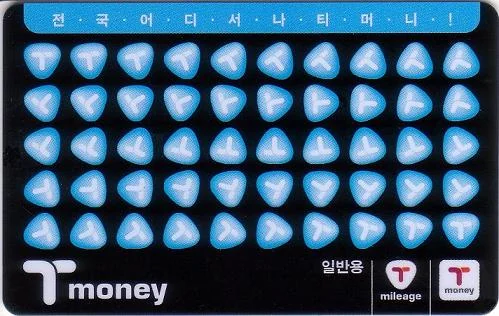
A T-money card is not a ticket. It is stored electronic money on a chip, and every awkward thing about it — the fee to get your balance back, the card price you never see again, the fact that your foreign credit card cannot top it up inside Apple Wallet — follows from that one fact.
Understanding it as e-money rather than as a transit pass tells you what to do differently: how much to load, when to stop loading, and which of the several cards on sale in Korea you should not buy.
What you pay, and what you never get back
You buy a blank card at a convenience store or a station machine and load it with cash. Basic designs are inexpensive; character editions cost more for the same function. There is no deposit in the sense used elsewhere in Asia — the card price is a purchase, not a bond.
For a normal physical T-money card, the issuer’s English user guide lists a 500 KRW service fee and excludes the card purchase price. Start with the remaining balance and subtract the fee once; fares already paid are already deducted from that balance. Checked 2026-10-07.
A defective or damaged card needs a separate assessment. We could not recheck the current defective-card policy, so this guide does not promise a card-price refund or a warranty period. Ask T-money about your card before relying on either.
The practical instruction is therefore about load size rather than about refunds. Top up in the amounts you will actually spend. A card you leave Korea with holding 40,000 KRW costs you a trip to a refund point and a fee; a card holding 3,000 KRW costs you 3,000 KRW and no errand at all.
Where can you refund an ordinary T-money card?
The issuer’s English guide describes a cash refund in Korean won at a sales or top-up location, with the physical card returned to you. This is the ordinary-card process; Climate Card refunds follow separate rules.
Participating convenience stores can handle remaining-balance refunds, but procedures and limits vary by location and card type. The Korea Tourism Organization directs travelers with more than 50,000 KRW to Tmoney Town near Seoul Station Exit 10. This does not establish a single limit for every convenience store or mean that Tmoney Town only pays into Korean bank accounts.
Before leaving Korea, check the refund point and payment method for your particular card. Keep top-ups modest so a large unused balance does not become a last-day errand.
The card in your phone, and the wall behind it
On Android, the Mobile T-money app turns an NFC phone into the card. On iPhone, a prepaid T-money card can be added to Apple Wallet, with Express Mode letting you tap through gates without unlocking the phone — Apple states this continues to work for a period after the battery runs down.
Then the wall. Apple’s own support documentation states that a South Korea-issued credit or debit card is required to purchase or top up a Tmoney card from Apple Wallet. Your foreign Visa sitting in the same Wallet will not do it.
Korean press coverage at the July 2025 launch reported that only prepaid T-money was supported, and that subsidised passes including the Climate Card and K-Pass were not compatible at that point.
Since then there have been reports of foreign-issued card top-ups being enabled in the Mobile T-money app, and of K-Pass support reaching iOS. We could not confirm either from a primary source and are not stating them as fact. Check inside the app before you rely on it. Cash top-up at a convenience store or station machine is the method that has never stopped working.
| Situation | What to expect |
|---|---|
| Normal physical card | Remaining balance minus the 500 KRW service fee. Card purchase price excluded; do not subtract past fares again. |
| Ordinary card at a participating refund point | Issuer guidance describes cash in Korean won and return of the card. Check the location’s limits. |
| Remaining balance above 50,000 KRW | KTO directs travelers to Tmoney Town near Seoul Station Exit 10; confirm your card’s procedure before visiting. |
| Defective or damaged card | Separate policy applies. Ask T-money to assess eligibility; no warranty-period claim is made here. |
| Climate Card short-term pass | Separate pass refund procedure; contact the operator before the use period ends. |
| Tmoney top-up inside Apple Wallet | Apple requires a South Korea-issued credit or debit card. |
Climate Card refunds follow a different process
The short-term Climate Card is a time-based pass, not an ordinary stored-value T-money card. Seoul ended new 30-day prepaid charging after August 31, 2026; the short-term passes remain available. See our transit passes guide for the transition to Climate Pass.
Seoul’s current English guidance says to request a short-term pass refund before the use period ends. It describes a calculation using the amount charged, transport usage and a 500 KRW fee, and says foreigners without a Korean bank account can visit Tmoney headquarters. Confirm the procedure for your pass before expiry. We could not reopen the issuer’s detailed refund page today, so we are not presenting the older 15-day filing wording as a current short-term-pass deadline.
The one journey where your Climate Card does not work
Worth knowing before it strands you at a bus door with luggage.
Airport Limousine Co. states on its own notice that on its airport buses, passengers pay the driver in cash or with a transit card — T-money or a postpaid transit card — and that the Climate Card and the Discover Seoul Pass are not accepted. A credit card cannot be processed on board at all; payment must be completed on arrival at Incheon Airport, and the operator states a driver may temporarily hold a passenger’s credit card to prevent unpaid fares.
So if the Climate Card is your everyday card, carry a plain T-money or cash on airport days. More on that journey in our Incheon Airport to Seoul guide.
Using it without thinking about it
Tap entering and leaving subway gates, since fares are distance-based. On buses, tap boarding and alighting — skipping the second tap is how people lose the transfer discount and occasionally get charged a maximum fare. In taxis, say you are paying by card and tap the terminal. At convenience store tills it works as e-money on the same tap.
The balance appears on the reader with every tap. That number is your entire account statement, so glance at it — a card that reads low on a Friday evening is a card that will fail you at a bus door on Saturday.
Whether a monthly pass beats pay-as-you-go depends on your commute rather than on general advice; that comparison is in our transit passes guide.
What we could not verify
We have not reverified the full ordinary-card channel-limit schedule or defective-card warranty terms. The English issuer guide confirms the ordinary cash-refund process and fee; the KTO guidance above identifies a route for balances above 50,000 KRW. Neither establishes every channel’s limit or payment method.
Ask T-money’s customer centre on 1644-0088 about your card and intended refund point. Bring the physical card; the ordinary-card English guide says it is returned with the cash refund.
Verification note. On October 7, 2026, an AI-assisted selective review checked the ordinary-card fee and cash-refund wording against T-money’s English guide, the high-balance destination against KTO, short-term Climate Card guidance against Seoul, and the Wallet funding requirement against Apple. Detailed normal-card and defective-card policy pages timed out. This was not a full recheck of every claim in this article. Rules and fees can change; email hello@90dayskorea.com to report a possible correction.
Sources
- T-money — English user guide: ordinary-card cash refund, card return, purchase-price exclusion and 500 KRW fee
- T-money official blog — participating convenience stores and location-specific refund conditions
- Korea Tourism Organization — transportation cards and refunds above 50,000 KRW
- Seoul Metropolitan Government — short-term Climate Card and refund guidance
- Seoul Metropolitan Government — 2026 Climate Card transition
- Apple Support — Add a transit card to Apple Wallet: Korea-issued card required for Tmoney top-up
- Korea Herald — Apple Wallet T-money launch coverage, 22 July 2025
- Airport Limousine Co. — payment notice: Climate Card and Discover Seoul Pass not accepted (Korean)
- T-money Co. — Mobile T-money official listing
Selective review completed 2026-10-07 for the refund and Apple Wallet items identified above. Other claims retain their earlier verification dates. Fees and procedures can change; confirm your card-specific case with the issuer.