
Last updated: August 2026
Every settling-in list for Korea tells you the same things: get your residence card, open a bank account, buy a SIM. Fine. But they hand you a flat list, and Korea does not work like a flat list.
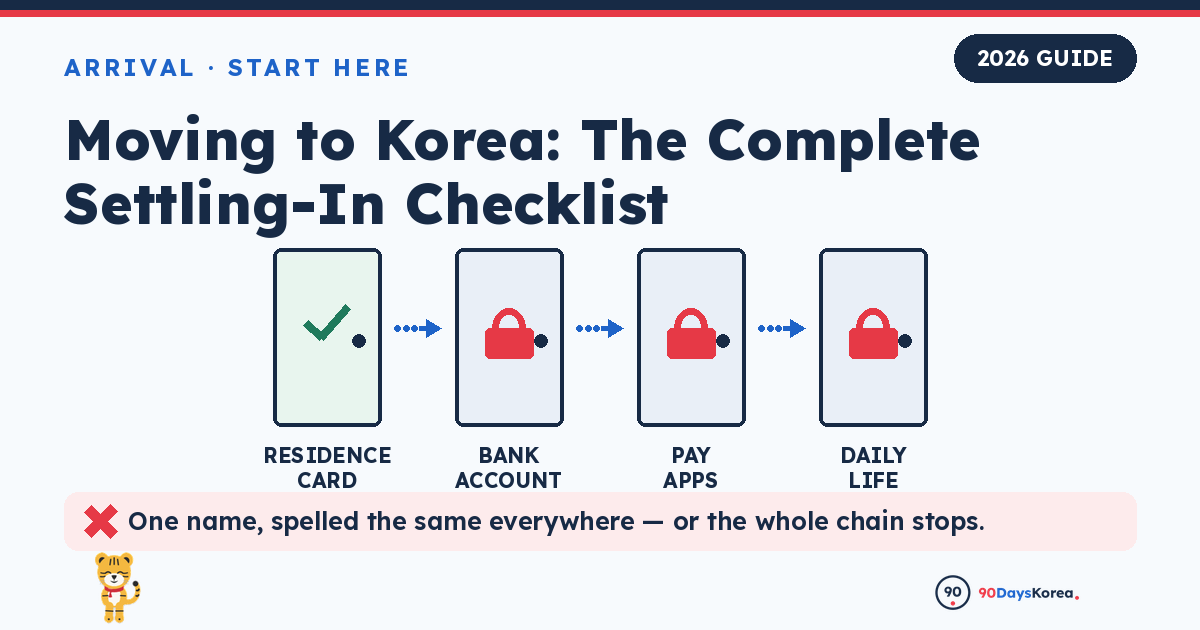
It works like a chain. Your bank account waits on your residence card. Your payment apps wait on the bank account. Delivery, taxis and shopping wait on the payment apps. And every one of those links quietly waits on something nobody mentions: your name being spelled the same way everywhere.
So this is not another list of tasks. It is the order — what blocks what, which single deadline is actually the law, and where people lose weeks by doing the right things in the wrong sequence.
TL;DR
- One real legal deadline: if you are staying more than 90 days, you must register as a foreign resident within 90 days of the date you entered. Everything else is convenience.
- The chain: residence card → bank account → payment apps → the apps that run daily life.
- Fix your name first. One inconsistent spelling across passport, residence card and phone contract will block verification at every step, and fixing it later means redoing what came before.
- Book before you need it. Immigration appointments and the paperwork behind them run on lead times, not on your schedule.
- A Korean phone number in your own name is the key that opens most Korean apps. Get it early.
- Nothing here needs perfect Korean — but a few things need the counter, not the app.
1. Week One: The Only Deadline That Is the Law
Under Korea's Immigration Act, a foreigner intending to stay more than 90 days must register with the local immigration office within 90 days of entry (with narrow exceptions for diplomatic and treaty-covered cases). That is the one clock with legal weight. Miss it and you are out of status; everything else on this page is just friction.
Three things belong in your first week:
- Start the residence card (ARC). Our step-by-step ARC guide covers documents and what happens at the office.
- Book the appointment early — slots, not walk-ins, decide your timeline. See booking a HiKorea appointment in English, and creating the HiKorea account you will need to do it.
- Get a Korean number in your own name. Not a data-only tourist eSIM — a line registered to you, because Korean identity verification runs through your carrier. Our SIM and eSIM guide explains the difference that matters.
If you are reading this on the way in from the airport, Incheon to Seoul is the more urgent page.
2. The Dependency Chain
This is the part other checklists leave out.
| To do this | You first need | Where it breaks |
|---|---|---|
| Open a bank account | Residence card (ARC) + Korean phone number | Name spelled differently on the two |
| Register a payment app | Korean bank account or card, phone in your name | Carrier name ≠ residence card name |
| Order delivery, taxis, shopping | A working payment method inside the app | Overseas card refused at registration |
| Get a customs code for overseas orders | Residence card — a passport alone means an in-person visit | Real-name verification failure |
| Exchange your driving licence | Residence card + entry/exit records | Name mismatch across licence and passport |
| Enrol in health insurance | Residence card and residency status | Timing, not paperwork |
Read it downward. Each row waits on the row above. Which is why the single most efficient thing you can do in week one is not on any other list.
3. Fix Your Name Before Anything Else
Korean systems match your romanised name across your passport, your residence card, your bank and your phone contract. A middle name that appears in one and not another, a space in a different place, family name first here and last there — any of these will stop a verification screen with nothing actually wrong with you.
This is the most common wall foreign residents hit here, so we wrote a full guide: why your name won't verify. Our free Name Checker shows how your name will render before a counter refuses it.
Do it first. Every link in the chain inherits whatever you set up at the start.
4. Money
A Korean bank account is the hinge of the whole chain — see opening an account as a foreigner for what to bring and which banks argue least.
Then two things people need sooner than they expect: sending money home (the apps beat the banks, and the limits are the part to read), and a stopgap for the weeks before your account exists — a WOWPASS prepaid card works in shops without any of the above.
For paying with your phone once the account is live: Kakao Pay and Korean payment apps, including why an overseas card usually cannot be registered.
5. Where You Live
Korean rentals have their own grammar — a deposit structure with no equivalent at home, and scams that target exactly the tenant who does not know it yet. Read renting in Korea: jeonse vs wolse before you sign anything.
Once you are in: how to sort your trash is not a small thing. Korea separates by category and by night, buildings enforce it, and getting it wrong is the fastest way to annoy your neighbours.
Seasonal reality, so you are not caught out: surviving your first Korean summer covers monsoon and heat.
6. Getting Around
Start with a T-money card — the simplest useful object in your wallet. Then decide whether a pass beats pay-as-you-go: K-pass vs Climate Card vs T-money.
Leaving the city takes a little more care: what your card actually covers outside Seoul, and whether a KORAIL PASS saves you anything on intercity trains.
For the nights when you want a car and not a timetable: taxis and Kakao T, including how to pay when the app refuses your card. Driving yourself is a longer project — exchanging your foreign licence, and note the clock: a foreign international permit is good for one year from the date you entered.
7. The Phone That Runs Your Life
Install the useful ones and skip the rest: 12 apps you actually need.
Then the three that break most often for foreign residents, in the order you will hit them: food delivery, taxis, and Coupang and online shopping — the last one adds a customs code if you order from overseas.
When you need a government site and cannot tell which: Korea Visa Portal vs HiKorea vs K-ETA.
8. Health
Get the structure straight before you need it: health insurance and how NHIS works, then seeing a doctor — clinics, costs and where English help actually exists. If aesthetics are on your list, K-beauty clinics covers the red flags.
Save the numbers today, not on the night you need them: emergency numbers every foreigner should save.
9. Month Two, and the Deadline Nobody Diarises
Two things worth putting in your calendar the week you arrive:
- Your stay's expiry date, minus a few months. Extensions run on lead times and some statuses cannot be handled online at all. Do not learn this in the last fortnight.
- Your international driving permit's one-year mark, if you plan to drive.
Then the part where Korea gets good: eating alone without it being strange (the honbap guide), budget shopping, traditional markets, a cold-noodle education, what closes during Chuseok, a 90-day slow-travel plan, and the 633 km bike path with its own passport. When family visits, hosting visitors covers their visa and arrival day.
Common Problems
"The bank turned me away." Almost always the residence card is not issued yet, or the name on your phone contract does not match it. Chain, not bad luck.
"Verification keeps failing and I do not know why." Start at the name guide. It is the cause more often than anything else.
"My card will not register in any app." Overseas-issued cards are the usual reason. A Korean debit card ends the argument.
"I cannot get an appointment for weeks." That is the system, not you. Book first, prepare documents while you wait.
"I did things in the wrong order." Common and recoverable. Fix the name, then work down the table in section 2.
FAQ
What is the one deadline I cannot miss? Registering as a foreign resident within 90 days of entry, if you are staying longer than 90 days. It is in the Immigration Act, and narrow exceptions apply to diplomatic and treaty-covered cases.
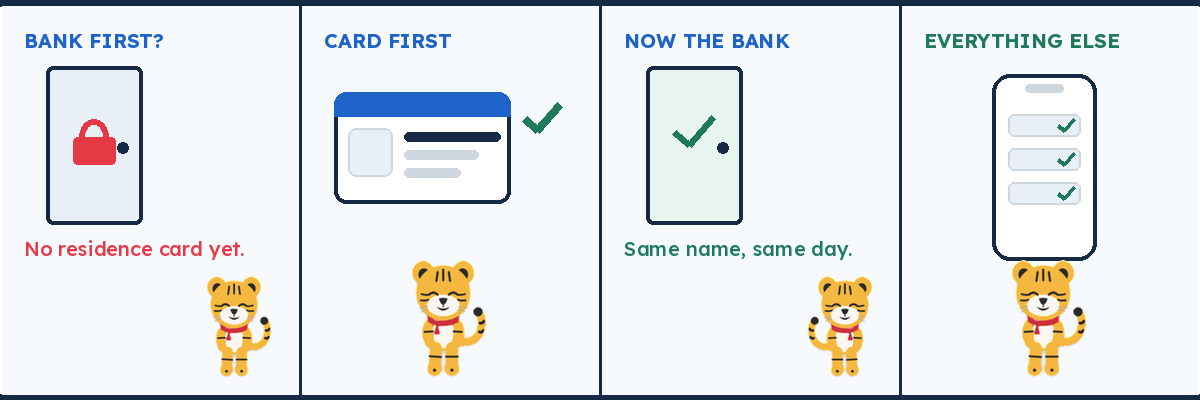
What should I do first — bank or residence card? Residence card. The account waits on it. Use cash or a prepaid card in the meantime.
Do I need a Korean phone number in my own name? For most Korean apps, effectively yes — identity verification runs through your carrier, and a line in someone else's name will not verify you.
Can I do all of this in English? Most of it. Some counters and screens are Korean-only, which is why we flag the ones where you should bring help.
How long does settling in actually take? The legal part fits inside your first weeks. The chain in section 2 typically resolves over the first month, and it goes faster if you fix your name before you start.
Official Resources
- Immigration Act, Article 31 (foreign resident registration) — Korea Law Information Centre, the statute behind the 90-day deadline
- HiKorea — immigration appointments and applications
- Korea Immigration Service — for case-specific questions, use the multilingual contact centre listed on our emergency numbers page
Working through this? Take our free settling-in checklist with you, and the full guide library has the rest.